
Montessori Toys by Age: The Practical-Life Guide (2026)
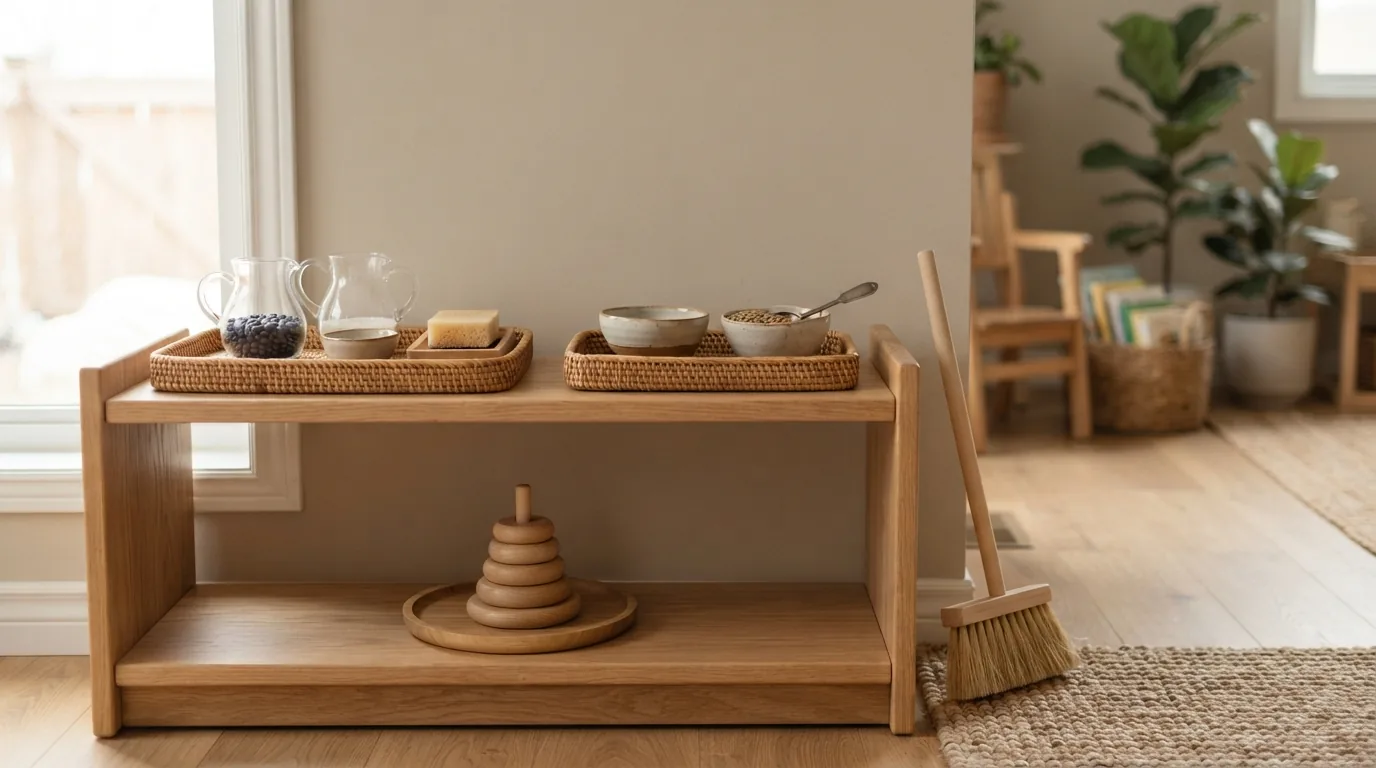
A toy is "Montessori" when it does one clear job, gives the child honest feedback without a grown-up hovering, is built from real materials the child can actually feel, and is sized for small hands doing real work. That's it. Lights, an app, and a "wooden" label do not qualify a toy — and most of the shelf marked "Montessori" online fails at least two of those four tests.
This guide sorts the real ones from the marketing, organized by developmental area and age band from infancy through preschool, with a full section on practical-life work — pouring, spooning, cleaning, dressing frames — because that hands-on daily practice is the part of Montessori almost every commercial "Montessori toy" list skips. Every pick is banded for price and checked against what children this age are actually working on, per CDC milestone guidance and the American Montessori Society.
What Makes a Toy Montessori (and What Doesn't)?
A genuine Montessori toy meets four criteria at once: it isolates a single skill, it's self-correcting so the child sees their own error, it's made of real materials (wood, metal, glass, cloth, ceramic), and it's child-sized for real practical work. Miss two of those and you've got an ordinary toy with a wooden veneer. Here's what each one means in practice.
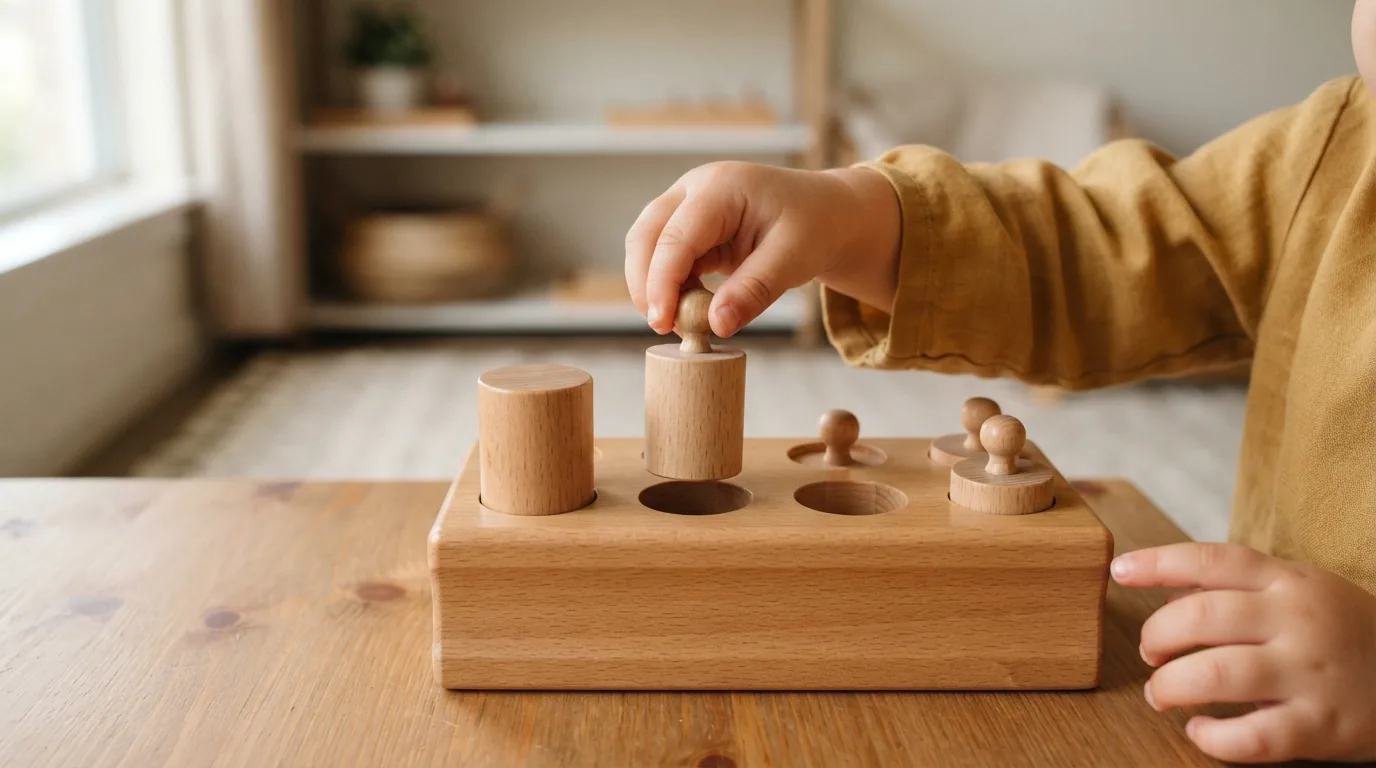
Single purpose. A Montessori material isolates one quality at a time so the child isn't overwhelmed. The knobbed cylinders teach size grading; sound boxes teach hearing. A toy that stacks, spins, lights up, and plays the alphabet teaches nothing well because attention has nowhere to land.
Self-correcting. The material itself tells the child whether they got it right — no adult verdict required. A cylinder that won't seat in its socket, a tower that topples when the blocks go out of order: the child reads the outcome and revises. That feedback loop, run independently, is where concentration and problem-solving actually grow (Source: Baan Dek, Montessori Institute).
Real materials. Montessori settings favor natural, breakable things — wood, ceramic, metal, glass. The weight and texture invite careful handling, and "breakable" is a feature: a real glass tumbler teaches a two-year-old to carry it with two hands in a way an unbreakable cup never will.
Child-sized and real. The environment uses appropriately sized furniture and tools so children can do actual work independently (Source: American Montessori Society). A toddler-height broom that really sweeps beats a plastic one that only pretends.
The "wooden equals Montessori" myth
Wood is one criterion out of four, not a certification. A wooden toy covered in painted cartoon faces, or a wooden "activity cube" bolted together from ten unrelated gadgets, is no more Montessori than a light-up plastic tablet. The material got fashionable, so manufacturers slapped it on everything and kept the busy, multi-function design Montessori specifically rejects. When you shop, ignore the material label and ask the four questions above. Plenty of the best Montessori toys — a metal spooning set, a glass pitcher, a cotton dressing frame — aren't primarily wooden at all.
TL;DR — What Are the Best Montessori Toys by Age?
For infants (0–12 months): high-contrast mobiles, an object-permanence box, grasping beads. For toddlers (1–3 years): a ring stacker, nesting cups, and real practical-life work — pouring, spooning, a child-sized cleaning set. For preschoolers (3–5 years): sensorial materials like the pink tower and knobbed cylinders, sandpaper letters, and dressing frames. Across every age, pick toys that isolate one skill, correct themselves, and use real materials. Four to six well-chosen items beat a full toy box.
How We Chose: Real Montessori Filters, Not Marketing
Every toy type here had to clear four filters. First, it has to match the four Montessori principles above — single-purpose, self-correcting, real materials, child-scaled. Second, developmental fit: it serves something a child that age is genuinely working on, cross-checked against CDC 18-month and 2-year milestone checklists. Third, safety — nothing failing the small-parts choke standard for under-3s. Fourth, honest pricing, banded so you know the commitment before you click.
This is a research-synthesis guide, checked against AMS guidance, CDC milestones, and the American Academy of Pediatrics toy report — not a sponsored roundup, and not a list of whatever's trending. Where a "Montessori" product is really just a battery toy in nicer packaging, we say so. For the wider thinking behind these picks, see our guide to open-ended toys for 2-year-olds.
Best Montessori Toys at a Glance (by Area and Age)
The table maps toy type to developmental area, best age fit, and price. Price key: $ = under $20, $$ = $20–50, $$$ = $50+.
| Toy type | Developmental area | Best age fit | Price band |
|---|---|---|---|
| High-contrast mobile (Munari/Gobbi) | Visual tracking | 0–4 mo | $$ |
| Grasping beads / interlocking discs | Reach and grasp | 3–9 mo | $ |
| Object permanence box | Grasp-release, cognition | 8–14 mo | $$ |
| Treasure basket (real objects) | Sensory exploration | 9–15 mo | $ |
| Wooden ring stacker | Fine motor, sequencing | 12–18 mo | $ |
| Nesting / stacking cups | Size grading | 12–24 mo | $ |
| Single-shape coin box | Posting, hand precision | 15–24 mo | $ |
| Pouring set (small pitchers) | Practical life, coordination | 18 mo–4 yr | $ |
| Spooning / transfer set | Practical life, pincer grip | 18 mo–3 yr | $ |
| Child-sized cleaning set | Practical life, independence | 2–5 yr | $-$$ |
| Dressing frames (button/zip/buckle) | Practical life, self-care | 2.5–5 yr | $$ |
| Realistic animal figures | Language, classification | 18 mo–4 yr | $$ |
| Knobbed cylinders | Sensorial, visual grading | 2.5–4 yr | $$ |
| Pink tower / broad stair | Sensorial, dimension | 3–5 yr | $$-$$$ |
| Sandpaper letters / movable alphabet | Pre-literacy | 3–5 yr | $$ |
| Number rods / spindle box | Early math | 3.5–5 yr | $$ |
Montessori toy types compared by developmental area, age fit, and price band.
Montessori Toys for Infants (0–12 Months)
The best Montessori toys for infants support the two jobs of the first year: focusing the eyes and learning that hands can reach, grasp, and let go. Everything is simple, holdable, and mouth-safe, because at this stage the mouth and hands are the research tools. No screens, no sound chips — an infant should be the active one.
High-contrast mobiles ($$, 0–4 mo). The classic Montessori progression runs from the black-and-white Munari to the colored Gobbi. A newborn can't yet reach, so a mobile gives the eyes something worth tracking. Caveat: it's a display object, not a grab toy — hang it out of reach and retire it once the baby starts batting at things.
Grasping beads and interlocking discs ($, 3–9 mo). Lightweight wooden rings or linked discs are easy for a new grasp to close around and pass hand to hand. Look for a shape a small palm can actually hold and confirm every bead is larger than choke-size.
Object permanence box ($$, 8–14 mo). A wooden box with a hole up top: the ball drops in, disappears, and rolls back out a tray. It drills grasp-and-release plus the cognitive lesson that hidden things still exist. One of the most genuinely absorbing first materials — babies repeat it for weeks. For a fuller infant lineup, see our guide to Montessori infant toys.
Montessori Toys for Toddlers (1–3 Years)
The best Montessori toys for toddlers refine the pincer grasp into deliberate placing, then hand it off to real practical work. This is the age most parents are shopping for — "montessori toys for 2 year olds" and "montessori toys 18 months" are the same developmental window — and it's where practical life becomes the main event. Start with the fine-motor classics, then move to real tools.
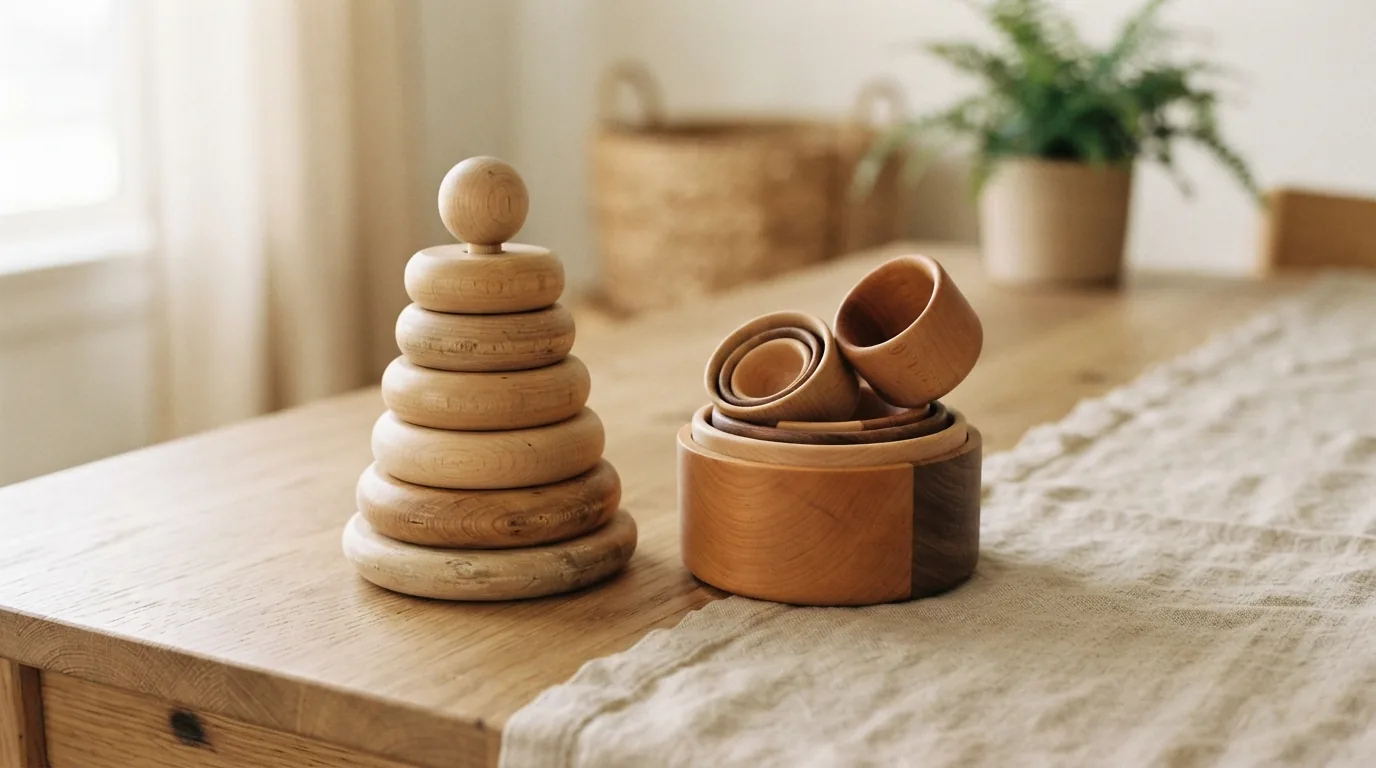
Wooden ring stacker ($, 12–18 mo). Grasp a ring, orient it, release it onto a dowel — a full fine-motor circuit in one object. A straight base with same-size rings is easier at 12 months; graduated rings that only stack in one order add a self-correcting challenge later.
Nesting and stacking cups ($, 12–24 mo). Probably the highest play-value-per-dollar item in this guide. They nest, stack, hide things, scoop bath water, and become pretend teacups by two. If your budget is one small toy, make it this.
Single-shape coin box ($, 15–24 mo). A wooden box with one slot for posting "coins" or a single circle hole. It's self-correcting and it isolates the posting skill. Skip the multi-shape sorters until 18 months-plus; they frustrate most toddlers who aren't ready for the discrimination yet.
Realistic animal figures ($$, 18 mo–4 yr). A small set of true-to-life animals — not cartoon versions — starts as a naming game, becomes matching, then pretend play. Montessori leans hard on reality-based toys at this age, so choose the accurate figures. Check each against choke-size; many farm sets hide tiny lambs and chicks.
For the broader picture at this age, our roundup of the best toys for 2-year-olds covers non-Montessori favorites too.
Montessori Practical-Life Toys: The Part Everyone Skips
Practical-life work — pouring, spooning, cleaning, and dressing — is the on-brand heart of Montessori and the piece almost every "Montessori toy" list ignores. It's everyday self-care and care of the environment done with real, child-sized tools (Source: American Montessori Society). Toddlers are wired for it: the CDC lists "copies you doing chores, like sweeping with a broom" as an 18-month milestone (Source: CDC). These aren't toys pretending to be work — they're work scaled down to a toddler.
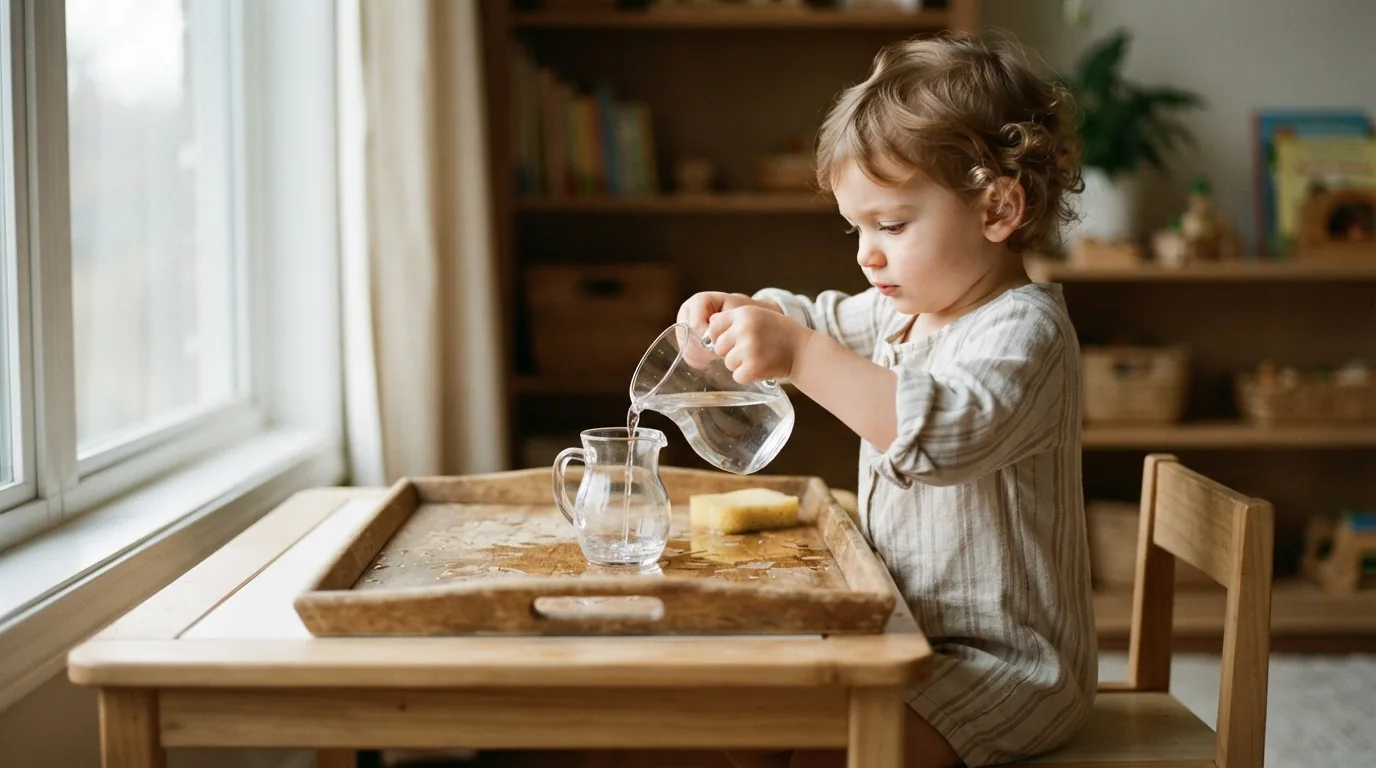
Pouring set (small pitchers) ($, 18 mo–4 yr). Two small pitchers and a tray. The child pours water — or dry beans to start — from one to the other, and the spill is the self-correction: they see it and adjust. It builds hand-eye coordination, precision, and concentration. Start with a tiny amount of dry rice, graduate to water. Real glass or ceramic pitchers work far better than plastic because the weight steadies the pour.
Spooning and transfer set ($, 18 mo–3 yr). Two small bowls and a spoon; the child transfers beans, pom-poms, or water from one to the other. The direct aim is spoon control; the indirect aim is the pincer grip that later drives writing, plus real focus. This maps straight onto the CDC's "eats with a spoon" milestone around age two (Source: CDC).
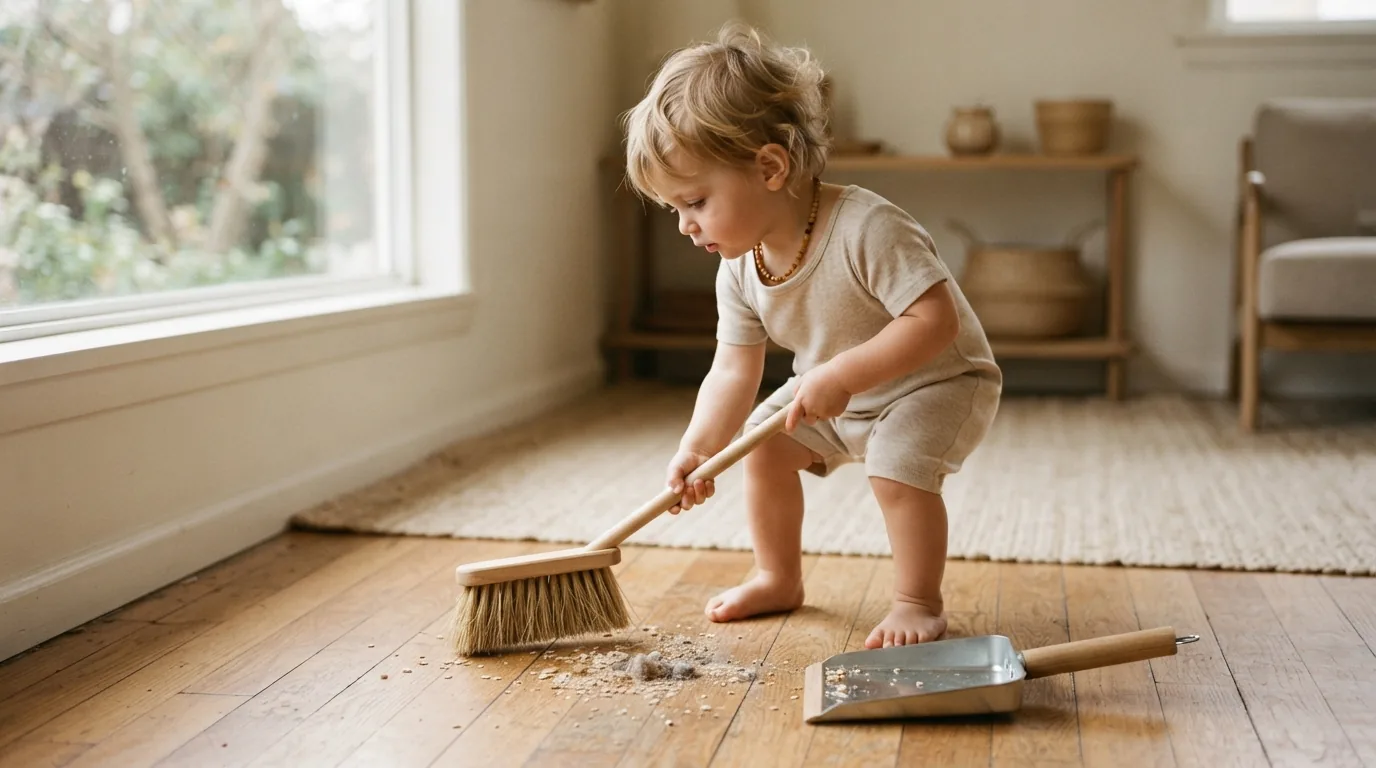
Child-sized cleaning set ($-$$, 2–5 yr). A toddler-height broom, dustpan, small spray bottle, and cloth. The one caveat: these have to actually clean, or the child sees through it instantly. A real (small) broom that moves crumbs beats a toy one every time — and it gets used daily for years. Routinely the sleeper hit of the whole list.
Dressing frames ($$, 2.5–5 yr). Wooden frames mounted with fabric that button, zip, buckle, snap, or lace. They isolate one fastening at a time so a child can practice the fiddly bit without the frustration of doing it on their own moving body. Self-correcting — the button's either through the hole or it isn't — and a direct on-ramp to dressing independently.
A note on the point of all this: practical-life work isn't about a clean floor. It's the training ground for concentration and independence, and it's nearly free — a real spoon and two bowls from your kitchen is a legitimate Montessori material. That's the honest catch with the whole category: much of the best practical-life "equipment" is already in your house.
Montessori Toys for Preschoolers (3–5 Years)
The best Montessori toys for preschoolers move into sensorial refinement and the first real academic materials — the "montessori teaching toys" and "learning toys" category. A three-to-five-year-old can grade fine differences in size and sound, and is entering the sensitive period for language and number. Practical life continues, just harder: real food prep, sewing, more complex fastenings.
Knobbed cylinders ($$, 2.5–4 yr). Blocks of graduated cylinders that each fit exactly one socket. Beautifully self-correcting: a cylinder in the wrong hole leaves one sticking out and one that won't seat. The knob also pre-trains the pencil grip.
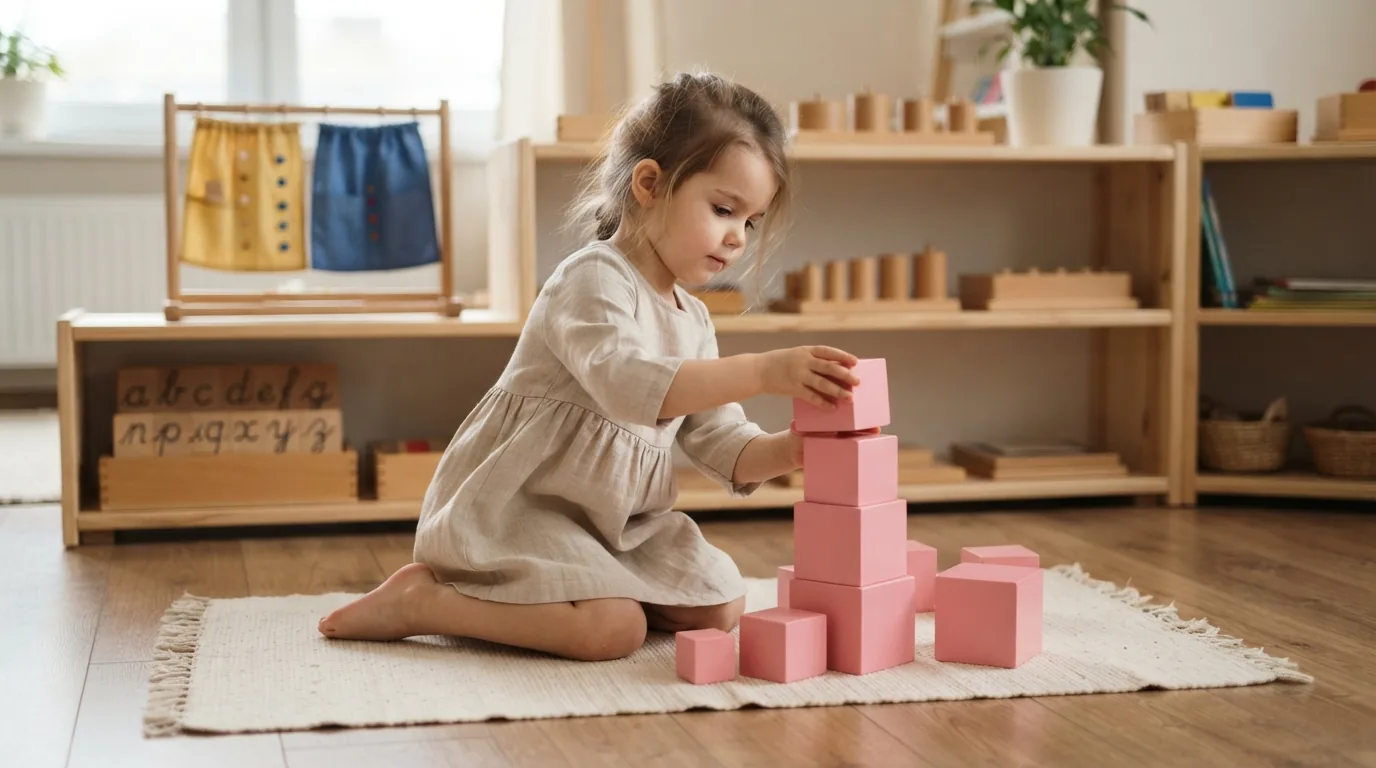
Pink tower or broad stair ($$-$$$, 3–5 yr). Ten wooden cubes graded from small to large; the child builds and rebuilds, refining visual discrimination of size. Real wood matters here for the weight cue. A caveat worth knowing: it's a single-concept sensorial material, not an all-day toy — its value is in focused, repeated work, not constant novelty.
Sandpaper letters and movable alphabet ($$, 3–5 yr). Textured letters the child traces while saying the sound, paired with loose letters for building words. This is Montessori's multisensory literacy on-ramp, and it's where "wooden montessori educational toys" actually earns the description. Introduce letter sounds, not names.
Number rods or spindle box ($$, 3.5–5 yr). Concrete quantities the child can hold — rods that get physically longer, or spindles counted into numbered compartments. Number becomes something you can feel before it's an abstract symbol.
And yes, practical life still leads: the "montessori toys for 5 year olds" that get the most use are usually a real (child-safe) knife for slicing banana, a small sewing kit, and plant care tools. Capability, not novelty, is what holds their attention now.
Montessori Gifts and Presents: What to Give and Where to Buy
The best Montessori gifts match the child's current developmental window and lean toward one real, well-made item over a pile — for a two-year-old, a pouring set plus nesting cups; for a preschooler, dressing frames or knobbed cylinders. As for where to buy Montessori toys: skip the big marketplace search for "montessori," which is where the mislabeled stuff lives, and instead judge each candidate against the four criteria above.
Fewer, better toys isn't just aesthetics. University of Toledo researchers gave toddlers either 4 toys or 16; with only 4, children played with each roughly twice as long and in more varied, more sophisticated ways (Source: University of Toledo, published in Infant Behavior and Development, 2018). So if grandparents want to contribute, pool it into one real material rather than five "montessori inspired" boxes. For a first-birthday version of this thinking, see our 1-year-old birthday gift guide.
What to Skip: "Montessori" Toys That Aren't
Three categories dressed up in Montessori branding that fail the criteria — leave them whatever the label says.
The wooden activity cube. Ten gadgets bolted to one wooden frame is the opposite of single-purpose. The material is right; the design is exactly what Montessori rejects.
Battery "Montessori" toys. If it lights up, talks, or plays a song when pressed, the toy is performing and the child is watching. The AAP is blunt that simple toys beat flashy ones and drive more parent-child talk than electronic ones (Source: HealthyChildren.org / AAP, 2018). Montessori's objection is the same in fewer words.
Pastel "Montessori inspired" sets that do nothing. Aesthetic-first bundles in muted colors that photograph well but isolate no skill and never self-correct. Pretty is not a developmental function.
FAQ
What actually makes a toy Montessori?
Four things at once: it isolates a single skill, it's self-correcting so the child sees their own errors without an adult, it's made of real materials like wood, metal, glass, or cloth, and it's child-sized for real work. A toy needs all four — being wooden alone doesn't make it Montessori.
Are all wooden toys Montessori?
No. Wood is one of four criteria, not a certification. A wooden activity cube with ten functions, or a wooden toy covered in cartoon faces, fails the single-purpose and reality-based tests. Manufacturers add wood because it sells; judge the design, not the material.
What are Montessori practical-life toys for toddlers?
They're real, child-sized versions of everyday tasks: pouring between small pitchers, spooning beans between bowls, a working toddler-height broom, and dressing frames for buttons and zips. They build coordination, concentration, and independence — and much of the equipment is already in your kitchen.
What are the best Montessori toys for a 2 year old?
A ring stacker, nesting cups, a single-shape coin box, and the start of practical life — a pouring set and a spooning transfer set. Two-year-olds are refining the pincer grasp and copying real chores, so real tools land better than pretend ones.
Where can I buy real Montessori toys?
Specialist Montessori suppliers and small makers are more reliable than searching "montessori" on a big marketplace, where mislabeled products dominate. Wherever you shop, test each item against the four criteria: single-purpose, self-correcting, real materials, child-sized.
How many Montessori toys does a child need?
Four to six accessible at a time, rotated. In the University of Toledo study, toddlers with 4 toys played longer and more creatively than those with 16 (Source: University of Toledo, 2018). Fewer, better materials deepen concentration; abundance dilutes it.
Sources
- American Montessori Society — Core Components of Montessori — practical life, prepared environment, child-sized materials.
- Baan Dek Montessori — Self-Teaching and Self-Correcting — the self-correction feedback loop.
- CDC — Milestones by 18 Months — copies chores like sweeping, tries to use a spoon, drinks from an open cup.
- CDC — Milestones by 2 Years — eats with a spoon, fine-motor refinement.
- HealthyChildren.org / AAP — The Best Toys Go Back to the Basics — simple toys over electronic; more parent-child talk.
- University of Toledo — Fewer Toys Lead to Richer Play — Dauch et al., Infant Behavior and Development (2018): 4 vs 16 toys.
More from Toy Guides
- Best Toys for 2 Year Olds: 20 Skill-Based Picks (2026)The best toys for 2 year olds, organized by the skills they build: gross motor, fine motor, language, pretend play and problem-solving, plus a price guide.
- Best Toys for 3 and 4 Year Olds (2026 Skill Guide)The best toys for 3 and 4 year olds by skill: pretend play, building, fine motor, gross motor, and puzzles, checked against AAP and CDC milestones.
- Montessori Infant Toys by Month: 0–12 Guide (2026)The complete Montessori infant toy sequence, month by month — mobiles, grasping beads, object permanence boxes, and stackers matched to each stage, 0 to 12 months.