
Best Toys for 3 and 4 Year Olds (2026 Skill Guide)
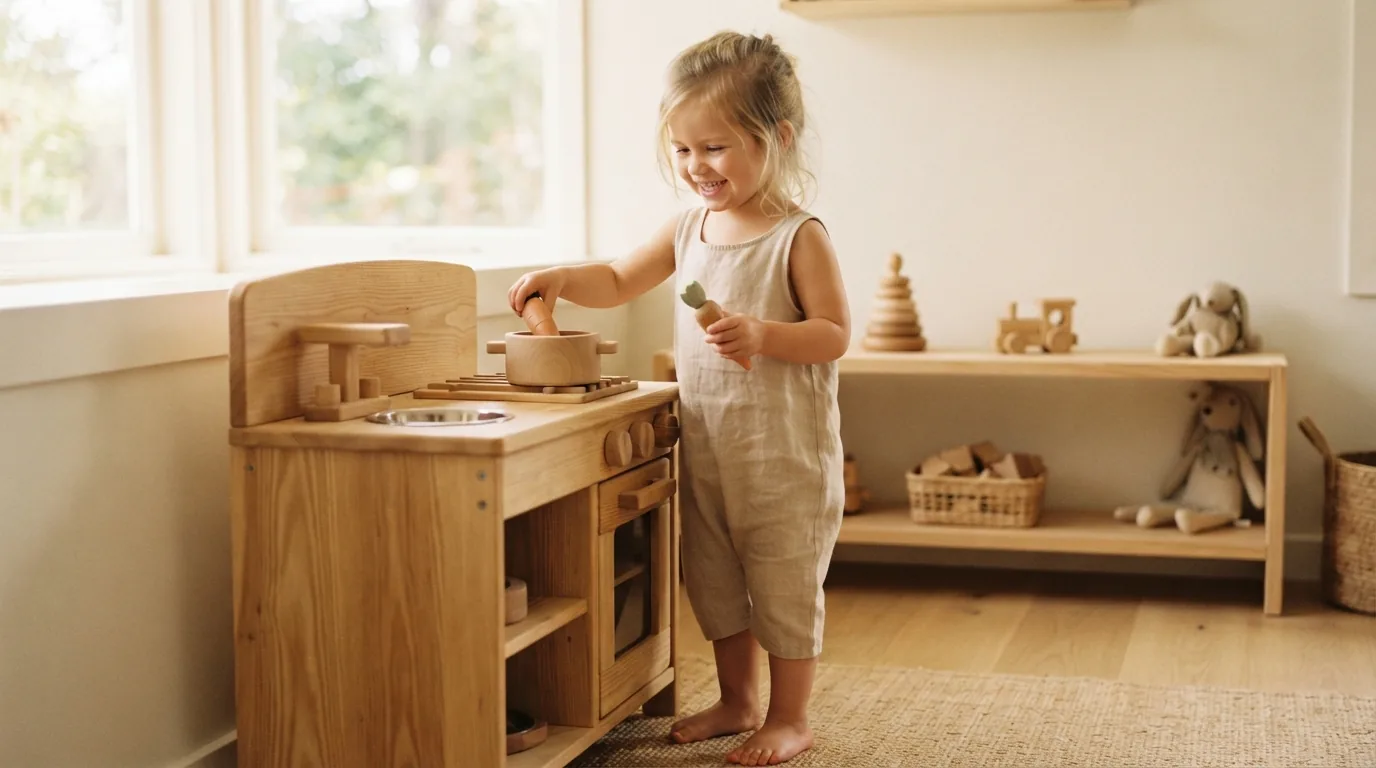
The best toys for 3 and 4 year olds feed the two things exploding at this age: big pretend-play stories and hands precise enough to draw, cut, and build. Think a play kitchen or doll set, a bin of wooden blocks or magnetic tiles, chunky crayons and threading beads, a balance bike, and a chunky floor puzzle. Skip the battery-powered stuff that does the playing for them.
This guide is sorted by the skill each toy builds, not by a random top-ten ranking, and checked against AAP milestone guidance and CDC's Learn the Signs milestones for this exact age band. If you're shopping for a birthday and short on time, the comparison table below will get you to a solid pick in about two minutes. Everything here is described by type and attribute, so you can buy the version you like without me steering you to a brand.
What Are the Best Toys for 3 and 4 Year Olds?
The strongest toys for 3-4 year olds match this stage's leap in pretend play and fine-motor control: a pretend-play setup (play kitchen, doll and carrier, or dress-up), open-ended builders (wooden blocks and magnetic tiles), pre-writing tools (chunky crayons, playdough, safety scissors, threading beads), a gross-motor pick (balance bike or trike), and a couple of puzzles or matching games. Five or six well-chosen open-ended toys beat a mountain of single-function ones.
How We Chose: Toys That Match the 3-4 Year Stage
Every pick had to clear four filters. First, developmental fit: does it serve something a 3- or 4-year-old is actively working on? By this age most children play elaborate make-believe, draw circles and start on squares, use child-safe scissors, hop and catch a bounced ball (Source: HealthyChildren.org / AAP). The CDC frames the pretend leap plainly, listing "pretends to be something else during play, like a teacher, superhero, or dog" among four-year skills (Source: CDC, Learn the Signs. Act Early.).
Second, open-ended play. The American Academy of Pediatrics is blunt about it: the best toys "need not be flashy or expensive or come with an app," and traditional toys prompt more talk and richer play than electronic ones (Source: HealthyChildren.org / AAP, 2018 toy report). Third, safety: three is the cutoff where the CPSC small-parts rule stops applying, but a just-turned-three who still mouths things needs the same choke-size caution (Source: CPSC, 16 CFR 1501). Fourth, price honesty, banded so you know the commitment before you click.
This is a research-synthesis guide reviewed against AAP and CDC guidance, not a sponsored roundup. For the philosophy underneath it, see our take on open-ended toys, and if your child is just aging up, our best toys for 2 year olds guide.
Best Toys for 3-4 Year Olds at a Glance (Comparison Table)
Here are the picks in skill order. Price key: $ = under $20, $$ = $20–50, $$$ = $50+.
| Toy type | Skill developed | Best age fit | Price band |
|---|---|---|---|
| Play kitchen + play food | Pretend narrative, sequencing | 3–5 yr | $$$ |
| Baby doll + carrier/stroller | Nurturing play, empathy | 3–5 yr | $$ |
| Dress-up / role costumes | Identity play, storytelling | 3–5 yr | $$ |
| Wooden play figures + animals | Small-world storytelling | 3–5 yr | $$ |
| Wooden unit blocks | Spatial reasoning, balance | 3–6 yr | $$ |
| Magnetic building tiles | 2D-to-3D geometry, engineering | 3–7 yr | $$$ |
| Marble run | Cause-effect, planning | 3–6 yr | $$ |
| Chunky crayons / triangular pencils | Tripod grasp, pre-writing | 3–5 yr | $ |
| Playdough + simple tools | Hand strength, creativity | 3–5 yr | $ |
| Threading beads / lacing cards | Bilateral coordination | 3–5 yr | $ |
| Child-safe scissors + paper | Cutting, hand control | 3–5 yr | $ |
| Balance bike | Balance, leg power | 3–5 yr | $$$ |
| Tricycle or scooter | Pedaling, steering | 3–5 yr | $$ |
| Bean bags / ball set | Throwing, catching | 3–5 yr | $ |
| Climbing arch / balance beam | Gross motor, core strength | 3–6 yr | $$$ |
| Chunky floor puzzle (12–24 pc) | Visual-spatial, persistence | 3–5 yr | $ |
| Matching / memory game | Working memory, turn-taking | 3–5 yr | $ |
| First cooperative board game | Rules, patience, counting | 3–5 yr | $$ |
Best toys for 3 and 4 year olds compared by skill, age fit, and price.
Imaginative & Pretend Play
Pretend play is the headline event of this age, so if you buy one thing, buy something that fuels a story. Around three, children start playing elaborate make-believe with dolls, animals, and people, and by four many are "increasingly inventive in fantasy play" and act out whole roles (Source: HealthyChildren.org / AAP). Toys that leave the plot to the child do the heavy lifting here.
Play kitchen with play food ($$$, 3–5 yr). The most-replayed toy in most homes at this age, because cooking, serving, and "no, that's too hot" mirror everything the child watches you do. Wooden versions last for years and resell well. Caveat: the food set matters more than the kitchen. A gorgeous kitchen with three plastic waffles gets abandoned fast, so budget for a decent set of cuttable or varied food.
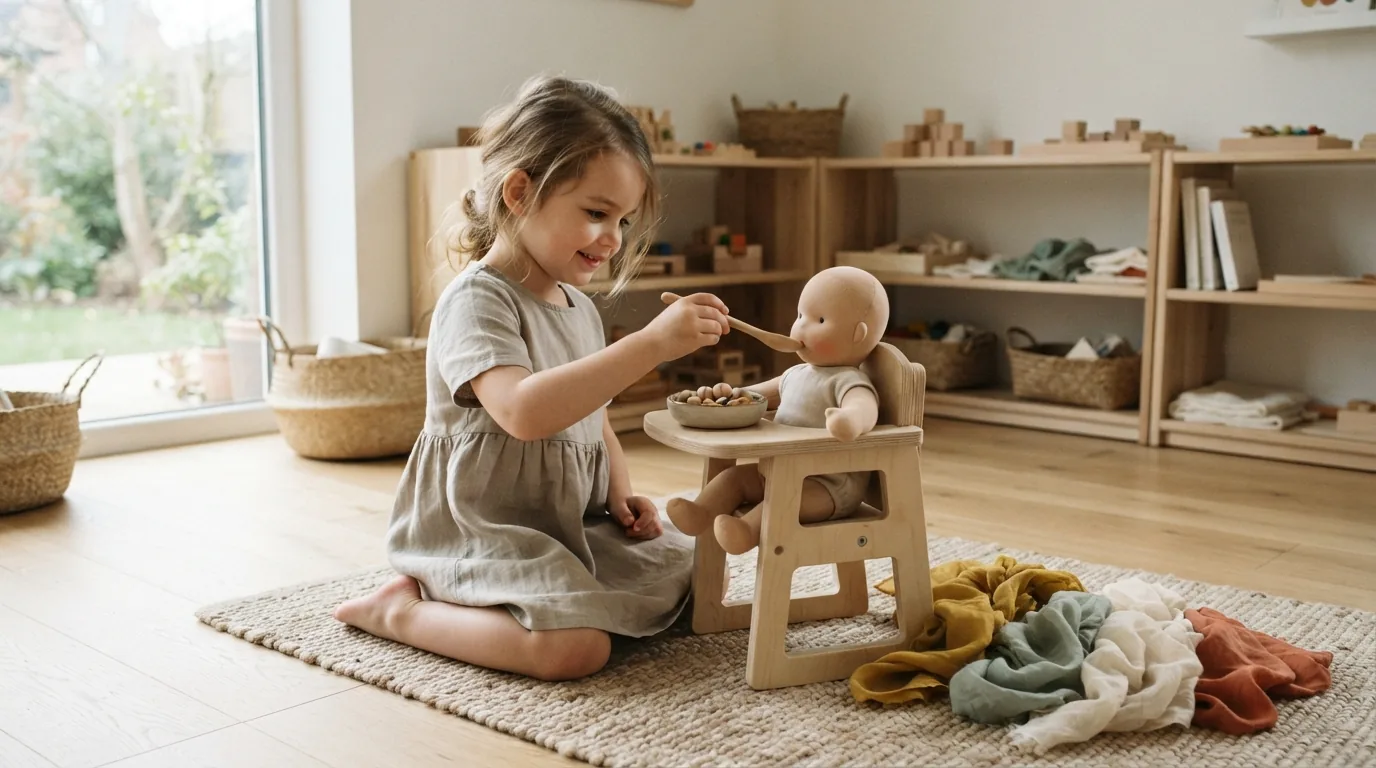
Baby doll with a carrier or stroller ($$, 3–5 yr). Feeding, rocking, and wheeling a doll around builds nurturing play, empathy, and a surprising amount of narration. This belongs on every child's list regardless of gender; nurturing play develops the same vocabulary and care instincts in boys. Skip dolls that cry, talk, or wet on batteries. The point is for the child to supply the voice.
Dress-up clothes and role costumes ($$, 3–5 yr). A firefighter jacket, a cape, a doctor kit, or a simple set of scarves lets a child try on being someone else, which is exactly the four-year milestone the CDC describes. Open sets (fabric, hats, a few props) beat a single licensed-character costume that only fits one story and one washing.
Wooden play figures and realistic animals ($$, 3–5 yr). A basket of small-world people and true-to-life animals becomes a farm, a zoo, a rescue mission, a family. Pair them with blocks and you have an afternoon. For a just-turned-three who still mouths, run the toilet-paper-tube choke test on the smallest pieces first.
Building & Early STEM
Open-ended builders are where early engineering and spatial reasoning live, and they scale from age three well into elementary school. Block and construction play is exactly the kind of object play the AAP links to problem-solving and early math intuition (Source: Pediatrics / AAP, The Power of Play, 2018). The best of these have no "right" answer, so a child can't outgrow them in a season.
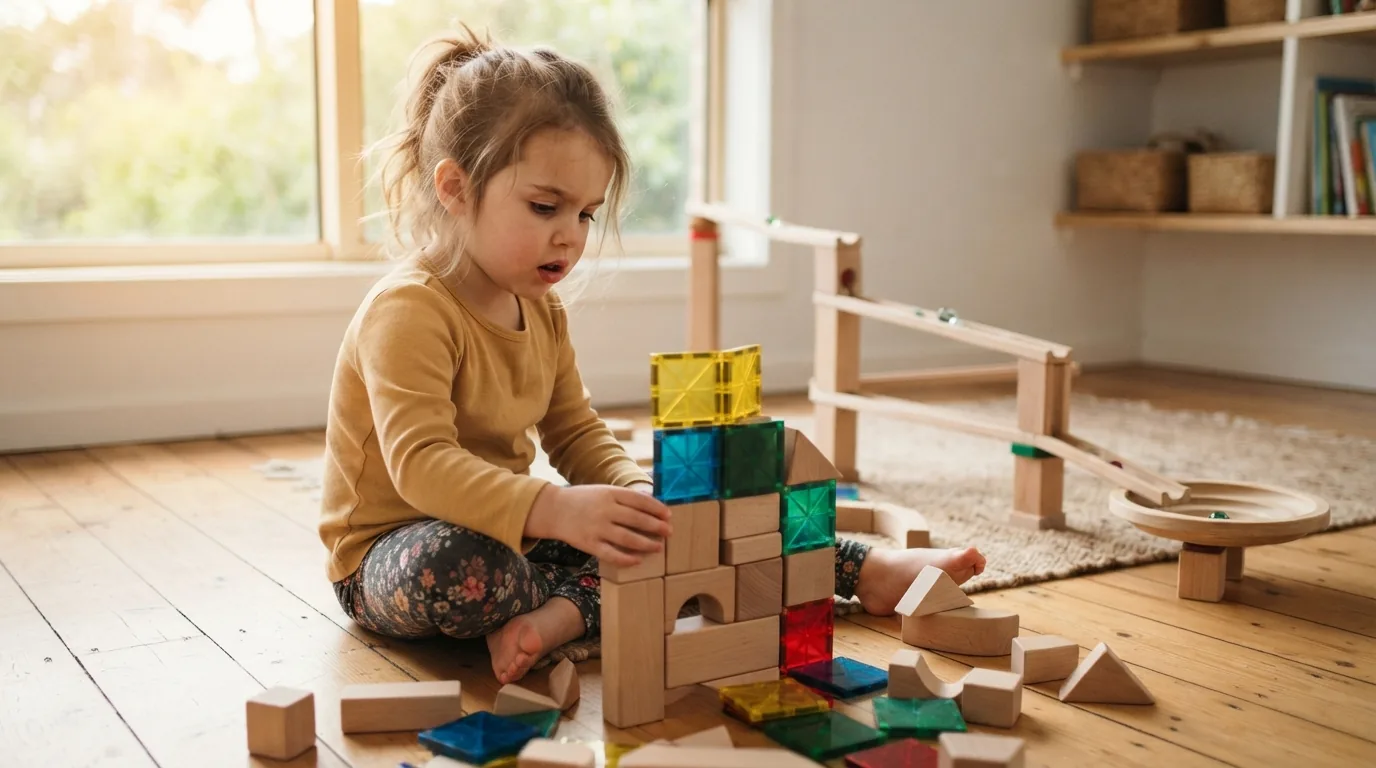
Wooden unit blocks ($$, 3–6 yr). A generous set of plain wooden blocks is the highest-ceiling toy in this guide: towers, roads, zoos, and eventually symmetry and simple math. Buy more pieces than feels necessary; ambition dies when the child runs out of blocks three floors up. A flat, hard surface helps more than any fancy shape pack.
Magnetic building tiles ($$$, 3–7 yr). Flat squares and triangles that snap into 3D shapes turn abstract geometry into something a preschooler can feel. They're genuinely absorbing and grow with the child for years. Two honest caveats: quality varies wildly, and cheap sets with weak magnets or thin seams frustrate more than they teach, so a smaller set of sturdy tiles beats a big box of flimsy ones.
Marble run ($$, 3–6 yr). Building a track and watching a marble race down is cause-and-effect made visible, plus real planning ("if I put it here, it falls off"). For three-year-olds, choose large marbles clearly over choke-size and a simpler set with fewer configurations. Elaborate 200-piece towers overwhelm this age and end up adult-built.
Fine Motor & Pre-Writing
This is the stage where hands get precise enough to draw a person and hold a crayon like a writer, so pre-writing tools earn their spot. Between three and four, children draw circles and begin squares, use child-safe scissors, and shift from a fist grip toward a proper tripod grasp (Source: HealthyChildren.org / AAP). None of these need a screen or a battery.
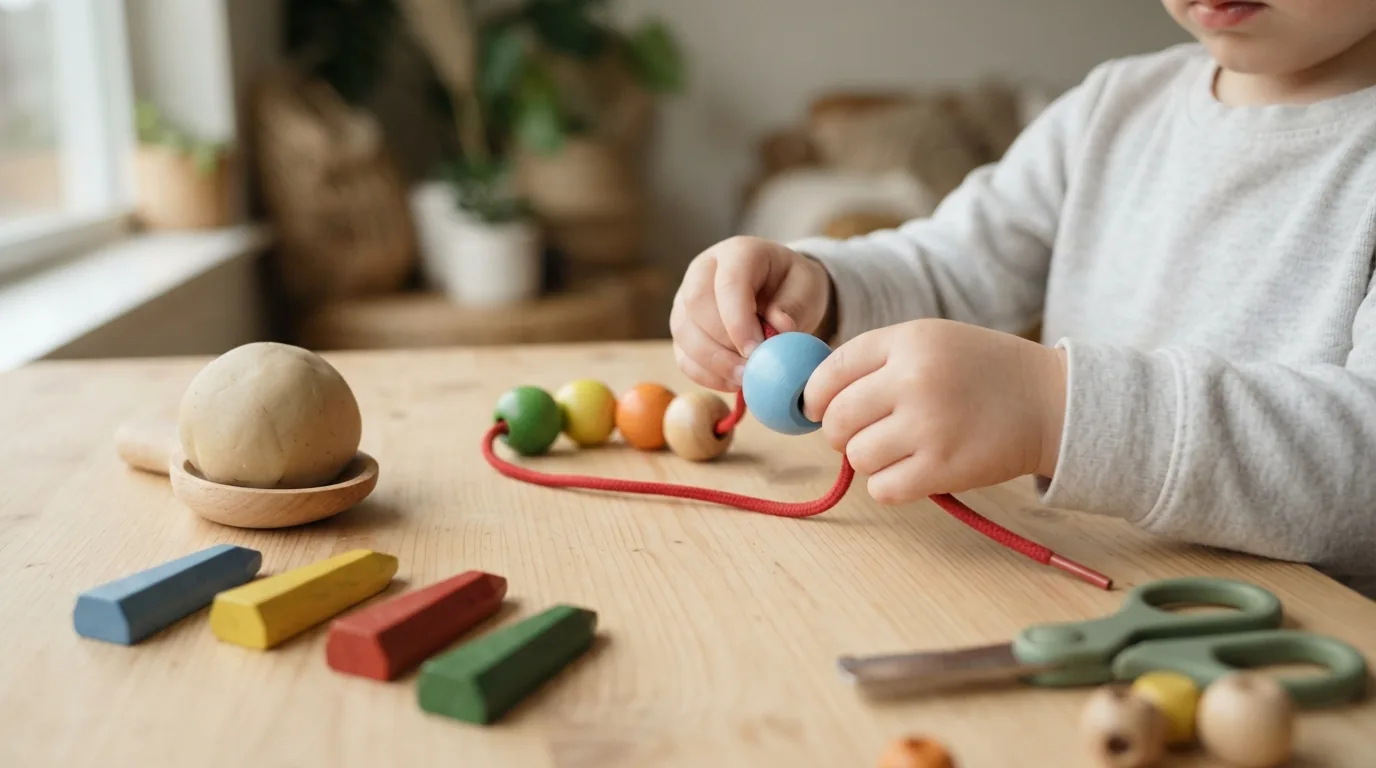
Chunky crayons or triangular pencils ($, 3–5 yr). Short, fat, or triangular crayons naturally coax little fingers into a tripod grip, which sets up handwriting later. Broken crayons are actually better here: a stub forces the fingers, where a long crayon invites a fist. Cheap, high-value, and the single most direct pre-writing gift.
Playdough with a few simple tools ($, 3–5 yr). Squishing, rolling, and pinching builds the exact hand strength that writing demands, and it's endlessly open-ended. A rolling pin, a blunt cutter, and a garlic-press-style extruder are plenty. Skip the sprawling themed sets; the dough plus three tools outlasts the branded ice-cream factory by a mile.
Threading beads or lacing cards ($, 3–5 yr). Getting a lace through a hole is two hands cooperating on a precise target, which is harder and more valuable than it looks. Start with large beads and a stiff-tipped lace. This is a quiet, focused activity that also happens to make necklaces, so it reads as a "girl gift" but serves every child's hands equally.
Child-safe scissors and scrap paper ($, 3–5 yr). Cutting is a genuine milestone at this age and a hugely satisfying one. Blunt-tip safety scissors sized for small hands, plus a stack of paper to shred, is a real skill-builder disguised as a mess. Supervise early attempts and expect confetti before you get shapes.
Gross Motor & Outdoor
Three- and four-year-olds are wiring up balance, power, and coordination, so the best outdoor toys reward big movement. By four, most children hop, stand on one foot for several seconds, catch a bounced ball, and pedal a trike (Source: HealthyChildren.org / AAP; CDC). Gifts that get them running, balancing, and throwing pay off in coordination and, honestly, in bedtime.
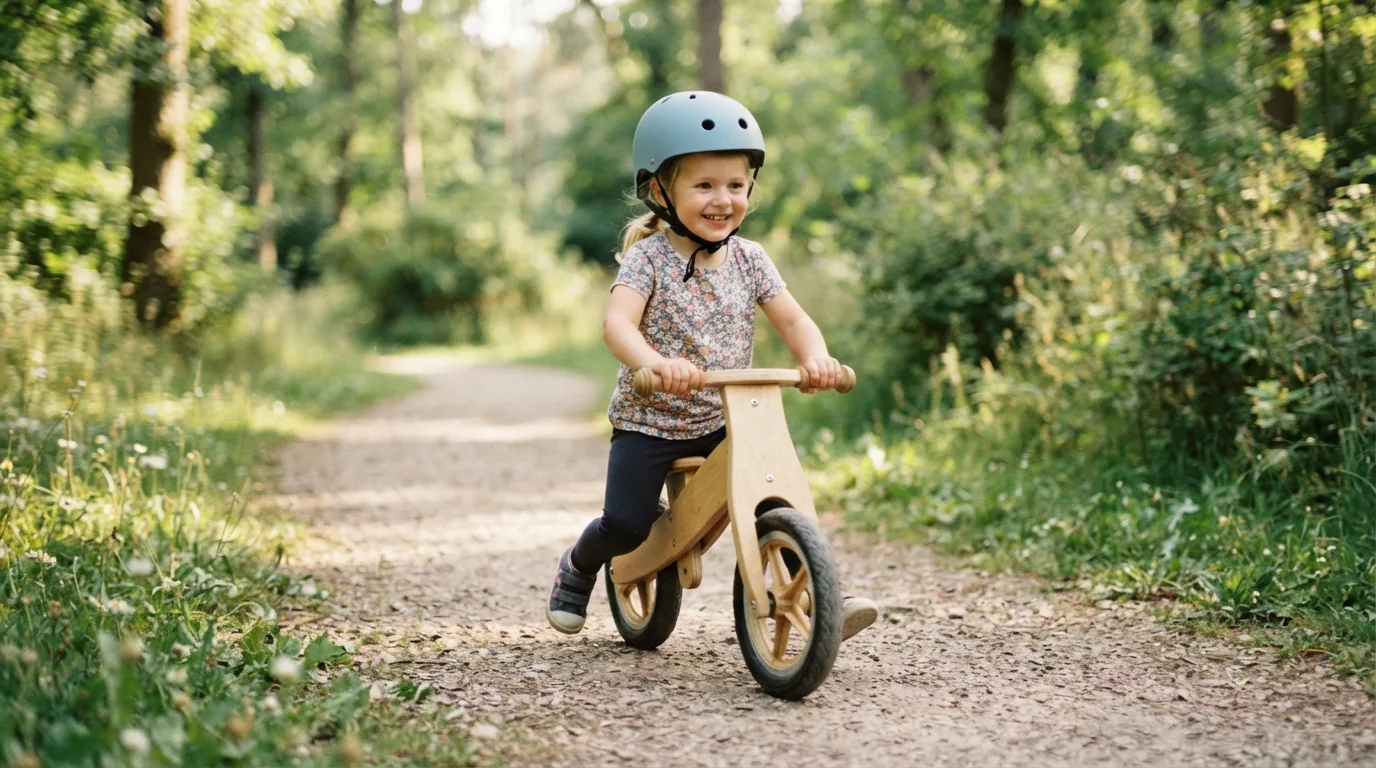
Balance bike ($$$, 3–5 yr). The clearest winner for teaching real cycling, because it builds balance first and skips training wheels entirely. Most kids who master a balance bike hop onto a pedal bike with almost no drama. Fit is everything: the child should sit and place both flat feet on the ground. Too tall and it just sits in the garage.
Tricycle or beginner scooter ($$, 3–5 yr). If cycling feels advanced, a trike teaches pedaling and steering, and a three-wheel scooter builds balance and leg drive with a low tip-over risk. Either one channels the "I want to go fast" energy safely. Always pair a scooter or bike with a properly fitted helmet from day one.
Bean bag or soft ball set ($, 3–5 yr). Throwing at a target and catching a bounced ball are literal milestones for this age, and bean bags are more catchable than balls for beginners. Cheap, packable, and endlessly adaptable into games you invent on the spot. A taped-down floor target turns it into a rainy-day activity too.
Climbing arch or balance beam ($$$, 3–6 yr). Indoor climbing and balancing equipment gives big-motor kids a sanctioned outlet that isn't your couch. A wooden arch, a low beam, or a foldable climber builds core strength and body awareness. It's a splurge, so treat it as a pooled group gift, and check the folded footprint against your actual floor space first.
Puzzles & Thinking Games
Puzzles and simple games are where persistence, memory, and turn-taking get their reps. Three- and four-year-olds can follow multi-step directions, recall parts of a story, and are just ready for their first real games with rules (Source: HealthyChildren.org / AAP). The trick is matching difficulty so the child feels the satisfying click of finishing, not the sting of giving up.
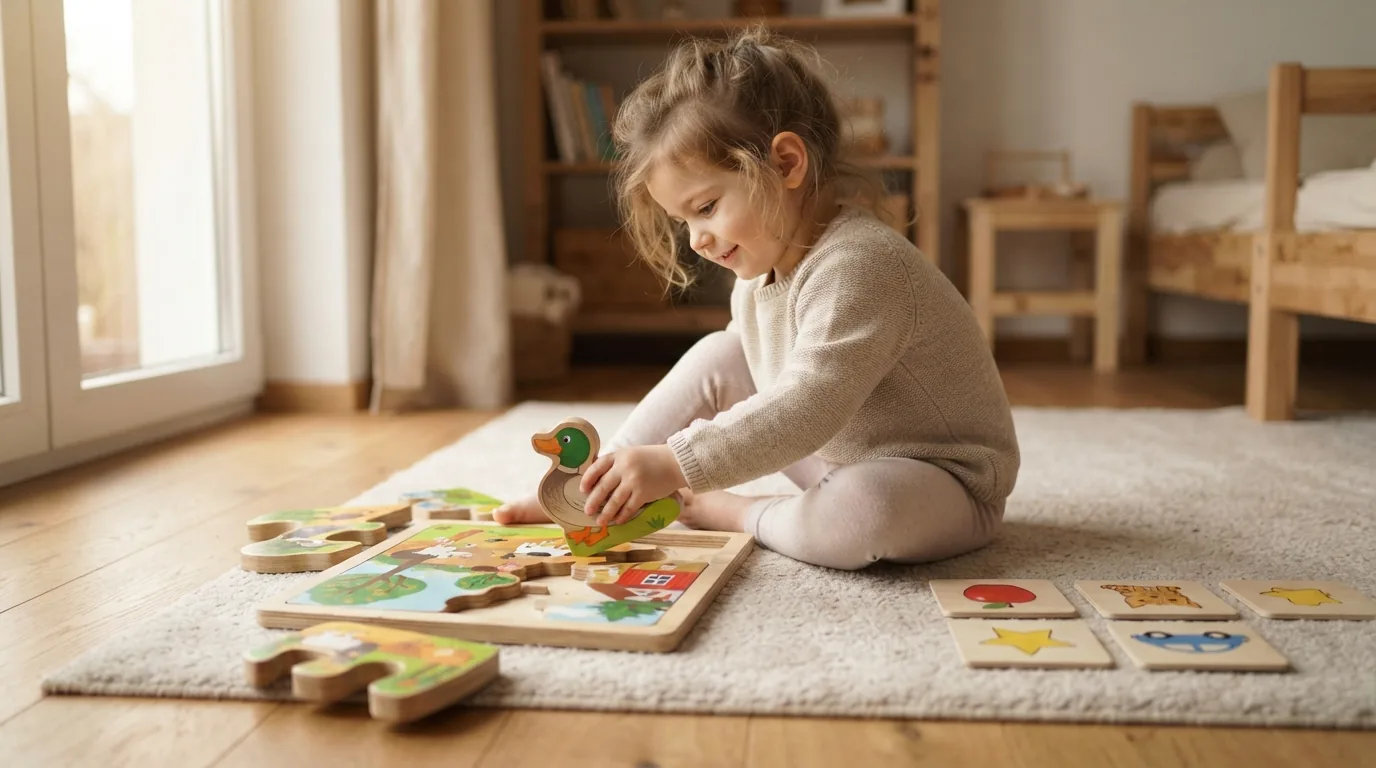
Chunky floor puzzle ($, 3–5 yr). A 12- to 24-piece puzzle with large, thick pieces is a workout in visual-spatial reasoning and stick-with-it-ness. Start nearer 12 pieces for a new three-year-old and size up as they cruise through. A single completed puzzle they can do independently beats a fancy one they need you for every time.
Matching or memory game ($, 3–5 yr). Flipping cards to find pairs trains working memory and gentle turn-taking, and preschoolers are often eerily good at it. Start with a small deck (six to eight pairs) face-up to build confidence, then flip them over. It's a five-minute game that packs flat for travel.
First cooperative board game ($$, 3–5 yr). A simple game where players work together rather than against each other teaches rules, patience, and counting without the meltdown that competitive losing brings at three. Look for short play time and no reading required. This is often the toy that surprises parents by getting requested again and again.
"But It's for a Boy" or "for a Girl": Reframe by Interest, Not Aisle
The best gifts for a 3 year old boy and the best gifts for a 3 or 4 year old girl come from the exact same skill list, because development at this age doesn't split by sex. Pretend play, fine-motor precision, and balance arrive on the same schedule for everyone. So instead of shopping a pink or blue aisle, shop the child's interests and the skills above.
Searching for toys for 3 year old boys or toys for 4 year old boys usually surfaces vehicles and construction, which are great; just make sure the "vehicle" is a real builder like blocks, a marble run, or magnetic tiles rather than a battery truck that drives itself. For gifts for a 3 year old girl or a unique gift for a 4 year old girl, the lists lean dolls, crafts, and threading, which are equally great, and equally valuable for boys. If you want a genuinely unique gift, reframe from this guide: a small-world animal set for the dinosaur kid, a doctor dress-up kit for the caretaker, a marble run for the builder, a balance bike for the mover. Match the child, not the marketing.
For more on why open-ended beats gendered, see our guide to Montessori practical-life toys, and for the youngest siblings, our 1 year old birthday gift guide.
What to Skip: Toys That Look Fun but Stall Play
A few categories to leave on the shelf, whatever the box promises.
Battery-powered light-and-sound toys. When the toy performs, the child watches. AAP guidance is direct that simple, traditional toys drive more language and richer play than electronic ones (Source: HealthyChildren.org / AAP, 2018). At three and four, when the child should be the author of the story, a talking toy just interrupts.
Single-function and licensed-character toys. A toy that does exactly one thing, or that only works inside one movie's story, is finished in a week. Open-ended materials get replayed for years because the child keeps inventing new uses.
"Educational" tablets and toddler screens. The AAP recommends limiting screen use for young children to about an hour a day of high-quality programming, co-viewed with an adult (Source: AAP, Media and Young Minds, Pediatrics). A tablet shaped like a toy is still a tablet, and it's a poor substitute for hands-on play at this age.
Toy overload itself. Ten mediocre gifts crowd out the four good ones, which is exactly what the next section is about.
How Many Toys Does a 3 Year Old Actually Need?
Fewer than you think, and fewer than they'll receive. When University of Toledo researchers gave toddlers either 4 toys or 16, the children with only 4 played with each one about twice as long and in more varied, more creative ways (Source: University of Toledo, published in Infant Behavior and Development, 2018). Abundance scattered attention; a smaller set deepened it.
The practical move for a birthday: rather than everyone arriving with a separate box, ask relatives to pool toward one splurge (a play kitchen, magnetic tiles, a balance bike, a climber) plus a few small skill-matched picks. Then rotate. Box up half the toys and swap them every few weeks, and old toys come back feeling new. A quieter room usually means deeper play.
FAQ
What should I get a 3 year old for their birthday?
Match a 3 year old birthday gift to this stage's leaps: a pretend-play setup (play kitchen, doll, or dress-up), an open-ended builder like wooden blocks or magnetic tiles, and a fine-motor pick like playdough or threading beads. One well-matched open-ended toy beats a stack of battery-powered ones. Pool budget for a bigger grow-with-them item like a balance bike.
What are the must-have toys for 3 year olds?
The core five: something for pretend play (play kitchen, doll, or costumes), open-ended blocks or magnetic tiles, pre-writing tools (chunky crayons, playdough), a gross-motor toy (balance bike or trike), and a chunky puzzle or matching game. Together they cover the pretend, building, fine-motor, movement, and thinking skills that define ages 3–4.
What do 3 year olds like to play with most?
Pretend play, hands down. Around three, children start acting out elaborate make-believe with dolls, animals, and people, so play kitchens, small-world figures, and dress-up get the most mileage (Source: AAP). They also love anything that builds, pours, or moves fast.
What are good gifts for a 3 or 4 year old girl?
The same skill-based picks that work for any child this age: a play kitchen, a doll and carrier, magnetic tiles, a balance bike, threading beads, or a first cooperative board game. For a unique gift for a 4 year old girl, reframe by her interest, a small-world animal set, a doctor dress-up kit, or a marble run, rather than defaulting to the pink aisle.
What are cool toys for 4 year olds?
Four-year-olds are ready for a step up: magnetic tiles and marble runs for real engineering, a balance bike or scooter for speed, safety scissors and craft kits for their newly precise hands, and first cooperative board games with simple rules. They can now pretend to be a whole character, so open dress-up and small-world sets shine.
How many toys should a 3 year old have out at once?
Keep only a handful accessible and rotate the rest. In the University of Toledo study, children with 4 toys played longer and more creatively than those with 16 (Source: University of Toledo, 2018). Box up half, swap every few weeks, and the "new" toys reignite interest for free.
Sources
- HealthyChildren.org / AAP — Developmental Milestones for 3-to-4-Year-Olds — pretend play, drawing, scissors, hopping, catching, tripod grasp.
- CDC — Learn the Signs. Act Early. Developmental Milestones — "pretends to be something else during play"; draws a person; movement milestones for ages 3–4.
- HealthyChildren.org / AAP — The Best Toys Go Back to the Basics — simple/traditional toys drive more talk and richer play than electronic ones.
- AAP, Pediatrics — The Power of Play (2018 clinical report) — object and pretend play build problem-solving and early math.
- AAP, Pediatrics — Media and Young Minds — screen-time limits and co-viewing for young children.
- CPSC — Small Parts for Toys and Children's Products (16 CFR 1501) — choke-hazard test cylinder; small-parts rule for under-3s.
- University of Toledo — Fewer toys lead to richer play experiences — Dauch et al., Infant Behavior and Development (2018): 4 vs 16 toys, longer and more creative play with fewer.
More from Toy Guides
- Best Toys for 2 Year Olds: 20 Skill-Based Picks (2026)The best toys for 2 year olds, organized by the skills they build: gross motor, fine motor, language, pretend play and problem-solving, plus a price guide.
- Montessori Infant Toys by Month: 0–12 Guide (2026)The complete Montessori infant toy sequence, month by month — mobiles, grasping beads, object permanence boxes, and stackers matched to each stage, 0 to 12 months.
- Montessori Toys by Age: The Practical-Life Guide (2026)What actually makes a toy Montessori (hint: not just wood) — plus the best picks by developmental area and age, with a practical-life focus.