
The best open-ended toys for 2-year-olds that actually get played with
What "open-ended" really means
An open-ended toy is one that does very little on its own, so your child can do a great deal. No batteries, no single right answer, no button that ends the game for them. The play comes from the child, and that is exactly the point.
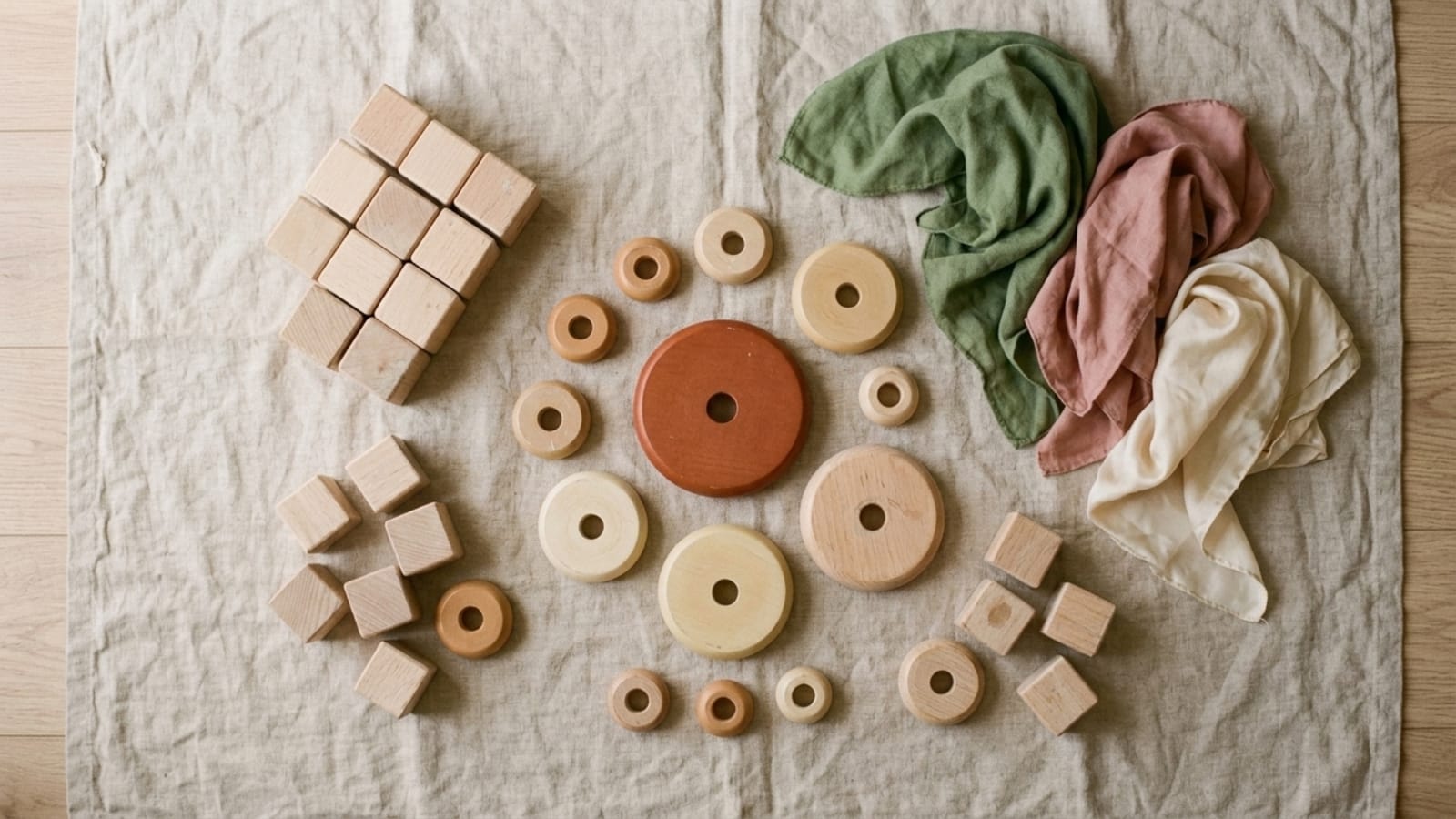
For two-year-olds, that usually means simple, sturdy, natural-material things: blocks, stacking cups, a basket of wooden shapes, a few scarves. The magic is not in the object. It is in how many different games one object can become across a year.
The nine that earned their shelf space
Every toy below survived at least twelve months of real, daily, occasionally violent toddler use in my house. I have listed them by how often they were actually reached for — not by price, and not by how good they looked in the box.
1. Plain wooden unit blocks
The single most reached-for thing we own. At two they were towers to knock down; by two and a half they were roads, beds for animals, and "cakes". A set of forty or so plain, uniform blocks beats any themed set — the plainer the block, the more things it can be.
2. Stacking and nesting cups
Cheap, indestructible, and quietly brilliant. They stack, nest, hide things, scoop bathwater, become hats for peg dolls and moulds for sand. Ours have been in daily rotation since five months old — no other purchase comes close on cost per hour of play.
3. Play silks
Three large squares of coloured fabric. That is the whole toy, and it has been a cape, a picnic blanket, a river, a peekaboo curtain and a baby sling for a wooden duck. Silks are the purest open-ended toy on this list: they do nothing at all until a child decides otherwise.
4. A basket of balls
Different sizes, weights and textures in one low basket. If your two-year-old is deep in a throwing phase (see my piece on schematic play), this is where you point it. Rolling, chasing, posting into boxes — gross motor practice that never needed a battery.
5. Simple wooden animal figures
A small family of sturdy animals is the start of pretend play. At two it is mostly naming, sorting and making the cow say hello to the pig; the stories arrive on their own by three. Chunky and open-mouthed-grin simple beats detailed and fragile every time.
6. A push wagon
Officially a walking aid, actually a delivery truck, a doll pram and a way to transport every block in the house from one room to the other. If your child is a transporter — always carrying, loading, hauling — a wagon feeds that schema for years.
7. Wooden peg dolls
Faceless little people that can be anyone. They ride in the wagon, sleep in the stacking cups, and get wrapped tenderly in play silks. The lack of a fixed face is a feature: the doll is happy, sad or asleep depending on the story, not the paint.
8. A chunky wooden truck
One solid, simple vehicle — no lights, no sounds, wheels that survive being driven off the table. It hauls blocks, animals and snacks. The motorised ones drive themselves; this one needs a driver, which is the entire developmental point.
9. A treasure basket of real things
Technically free: a whisk, a wooden spoon, a metal tin, large fabric scraps, a scrubbing brush. Two-year-olds are fascinated by the real objects adults use, and a rotating basket of safe household things often out-competes everything above it on this list.
The three bestsellers I quietly gave away
A singing activity table, a light-up learning cube, and a pop-up toy with exactly one trick. All bestsellers. All beautiful. All ignored within a week because they only did one thing — and did it at the child, instead of with them. A good toy grows with the child; a clever toy entertains them once.
More from Toy Guides
- Best Toys for 2 Year Olds: 20 Skill-Based Picks (2026)The best toys for 2 year olds, organized by the skills they build: gross motor, fine motor, language, pretend play and problem-solving, plus a price guide.
- Best Toys for 3 and 4 Year Olds (2026 Skill Guide)The best toys for 3 and 4 year olds by skill: pretend play, building, fine motor, gross motor, and puzzles, checked against AAP and CDC milestones.
- Montessori Infant Toys by Month: 0–12 Guide (2026)The complete Montessori infant toy sequence, month by month — mobiles, grasping beads, object permanence boxes, and stackers matched to each stage, 0 to 12 months.