What "schematic play" is — and why your toddler keeps throwing things
The chaos is a hypothesis
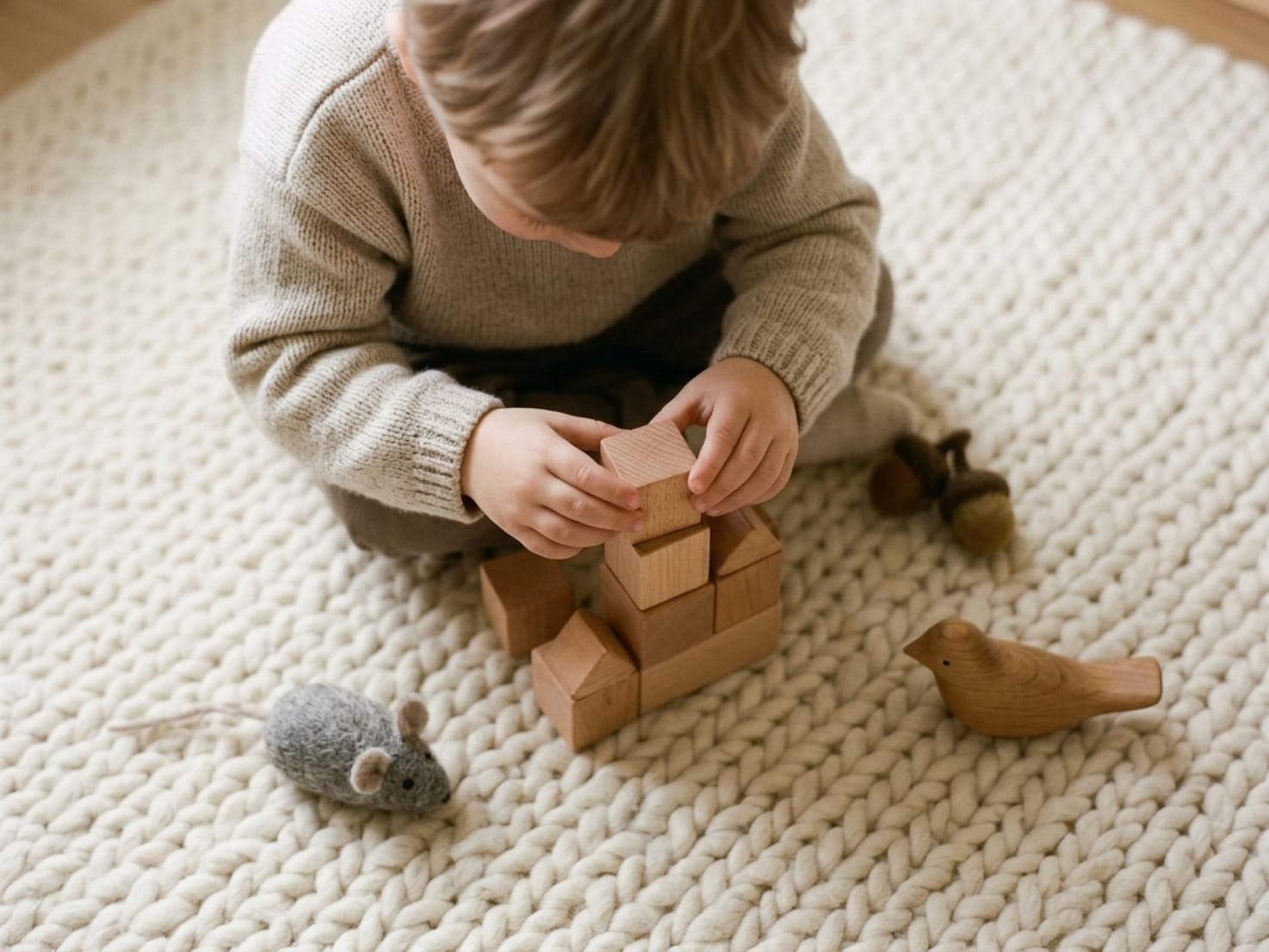
When a toddler drops the same block off the highchair for the fortieth time, they are not testing your patience — they are testing gravity. Those repeated patterns have a name: schemas. A schema is a chunk of behaviour a child runs over and over to figure out one rule about how the world works. Throwing is one. So is spinning, wrapping, carrying, and lining things up in a row that must not be disturbed.
The idea goes back to Jean Piaget, who described schemas as the mental building blocks children use to make sense of experience. Decades later, a British researcher named Chris Athey took that theory out of the lab and into real nurseries. Through the Froebel Early Education Project (1973–1978) and her book Extending Thought in Young Children, she showed that these repeated patterns are visible, nameable, and — crucially for tired parents — feedable (Source: Famly, 2023). She defined schemas as patterns of behaviour that sit underneath the surface of whatever a child happens to be playing with.
Here is why that matters at 7am with cereal on the floor: once you can name the schema, the behaviour stops reading as defiance and starts reading as research. A child obsessed with throwing is not naughty. She is collecting data on trajectory. Same brain, different question from the toddler wrapping every doll in a tea towel. It's one of the most useful lenses in the whole play & development toolkit.
The main schemas, and what each one is really asking
Most early-years educators work with a core set of schemas. You will rarely see just one — kids mix and match, and a single child can run three at once for a fortnight and then move on. Below are the ones I see most often in the two-to-four range, what the behaviour looks like from the outside, and what actually feeds it instead of fighting it.
| Schema | What you see | How to feed it |
|---|---|---|
| Trajectory | Throwing food, dropping toys off the sofa, kicking, pouring water out, running full-tilt at things | A basket of soft balls and beanbags, a "throwing corner," pouring stations at the sink, ball runs |
| Rotation | Spinning wheels, twisting knobs, turning in circles until dizzy, watching the washing machine | Toys with wheels, spinning tops, a salad spinner, whisks, taps and locks to turn |
| Enclosing / Enveloping | Wrapping dolls in blankets, climbing inside boxes, filling then covering containers, painting over a whole page | Fabric scraps and scarves, cardboard boxes, dens, nesting cups with lids |
| Transporting | Carrying objects room to room, filling bags and buckets, never leaving a toy where it started | Baskets, small buckets, a toy wheelbarrow or trolley, a backpack for "deliveries" |
| Connecting / Disconnecting | Joining and pulling apart, taping things together, coupling train carriages, then dismantling it all | Duplo, train tracks, magnetic tiles, string and pegs, tape they are allowed to use |
| Positioning | Lining cars up in a precise row, arranging by size, meltdown if the order is touched | Sorting trays, loose parts to arrange, pattern-making with stones or buttons |
| Orientation | Hanging upside down, peering between their legs, climbing to look down from height | Safe climbing, a low mirror, a tunnel, "looking from up high" on your shoulders |
(Schema list adapted from early-years practice; see Famly, 2023, and One Hundred Toys.)
Now let me slow down on the ones that cause the most laundry and the most confusion.
Trajectory: the thrower
What it's asking: Where does this go if I let it go? Trajectory is the most misread schema because the output — food on the wall, a remote control airborne — looks purely destructive. It isn't. A child throwing is studying force, direction, and how gravity behaves on different objects. A grape falls differently from a spoon, and she wants to know both.
The everyday misread is treating every throw as aggression. Sometimes it is frustration, sure. But most repetitive dropping and lobbing is pure trajectory experiment, and punishing it just teaches a child that curiosity gets you in trouble.
Feed it: give the schema a legal home. A basket of soft balls, a few beanbags, and one agreed spot where throwing is fine. Pouring water between cups at the sink scratches the same itch with zero breakage. My rule with my own two was simple: "We don't throw hard things, but you can throw these, here." I have rounded up the specific soft, throwable options I trust in this list of open-ended toys for two-year-olds.
Enclosing and enveloping: the wrapper and the box-dweller
What it's asking: What fits inside what — and what happens when I'm inside too? Enclosing is filling a container or drawing a border around something. Enveloping is covering it completely — wrapping the doll, burying their hands in sand, climbing into the empty box and pulling the flaps shut.
The misread here is "they never play with the actual toy, only the box." Correct — because right now the box is the toy. That plain cardboard delivery box is doing more developmental work than the plastic thing that came in it.
Feed it: scarves and fabric scraps for wrapping, a proper den, nesting cups with lids, and yes, keep a good box. It costs nothing and it is exactly what their brain ordered.
Transporting: the hoarder-in-motion
What it's asking: Can I move this whole set of things from A to B? You know this one if your kitchen utensils keep turning up in the bedroom. Transporters carry objects around in bags, buckets, pockets and trucks, and they are rarely satisfied until everything has been relocated at least once.
The misread is "they just make a mess and never finish anything." The moving is the activity; arriving is beside the point.
Feed it: give them the right vehicles. A small bucket, a shoulder bag, a wheelbarrow or trolley. Set a "delivery" game — bring me three soft things from the other room — and the schema does tidying for you.
Connecting and positioning: the engineer and the orderer
Connecting kids join and separate: train carriages, tape, magnetic tiles, string tied to anything that will hold still. The misread is impatience — "they build it just to smash it" — but disconnecting is half the experiment. Feed it with construction toys that click together and pull apart cleanly.
Positioning kids line things up with startling precision and lose it completely if you nudge the row. This is not early OCD; it is a child sorting the world into order and testing whether order holds. Feed it with sorting trays and loose parts, and — where you can — respect the arrangement rather than "tidying" it away mid-game.
How to feed a schema instead of fighting it
You cannot switch a schema off. It will run until the child has the answer, and then it quietly retires on its own. What you can do is give it a better home: the right material, an allowed spot, and a bit of language that names what they're doing ("you're seeing where it lands!"). You keep the learning and lose the broken plates.
Three things that have held up across both my kids and years of reading the research:
- Swap the object, not the behaviour. Don't stop the throw — hand over something soft to throw.
- Watch for a fortnight, then stock up. Schemas come in waves. Once you spot the current one, a couple of cheap, well-chosen materials go further than a whole toybox.
- Name it out loud. Naming the schema helps you stay patient and helps the child build the words for their own thinking.
If you'd rather start from a curated shelf than guess, my round-up of the best toys for two-year-olds is sorted with these schemas in mind — open-ended things that can serve a thrower one month and a transporter the next.
None of this requires a course or a cupboard of special equipment. It mostly requires a reframe: the mess is not the problem to solve. The mess is the report the experiment is generating. Read it, feed it, and it moves on.
FAQ
Is schema play the same as Montessori? No, but they get along well. Schemas come from Piaget and Chris Athey's early-years research, while Montessori is a distinct educational approach. They overlap because both respect a child's self-chosen, repetitive work as real learning rather than mess to be managed.
At what age do schemas show up? You'll notice them most strongly from around 18 months to four years, when children have the mobility to run experiments but not yet the language to explain them. Babies show early versions too — dropping a spoon from the highchair is textbook trajectory.
My child is doing several schemas at once — is that normal? Completely normal. Children commonly run two or three schemas in the same period and cycle through many over the early years. Mixing is a sign of busy, healthy exploration, not confusion.
When should throwing actually worry me? Repetitive experimental throwing is developmental. Be more attentive if throwing is aimed to hurt, escalates with distress, or comes with other sudden changes in behaviour or development — that's worth raising with your health visitor or pediatrician.
Sources
- Famly — Play schemas and why they matter (2023)
- Chris Athey, Extending Thought in Young Children: A Parent–Teacher Partnership — publisher listing
- One Hundred Toys — A guide to schema play in toddlers