
Montessori Infant Toys by Month: 0–12 Guide (2026)
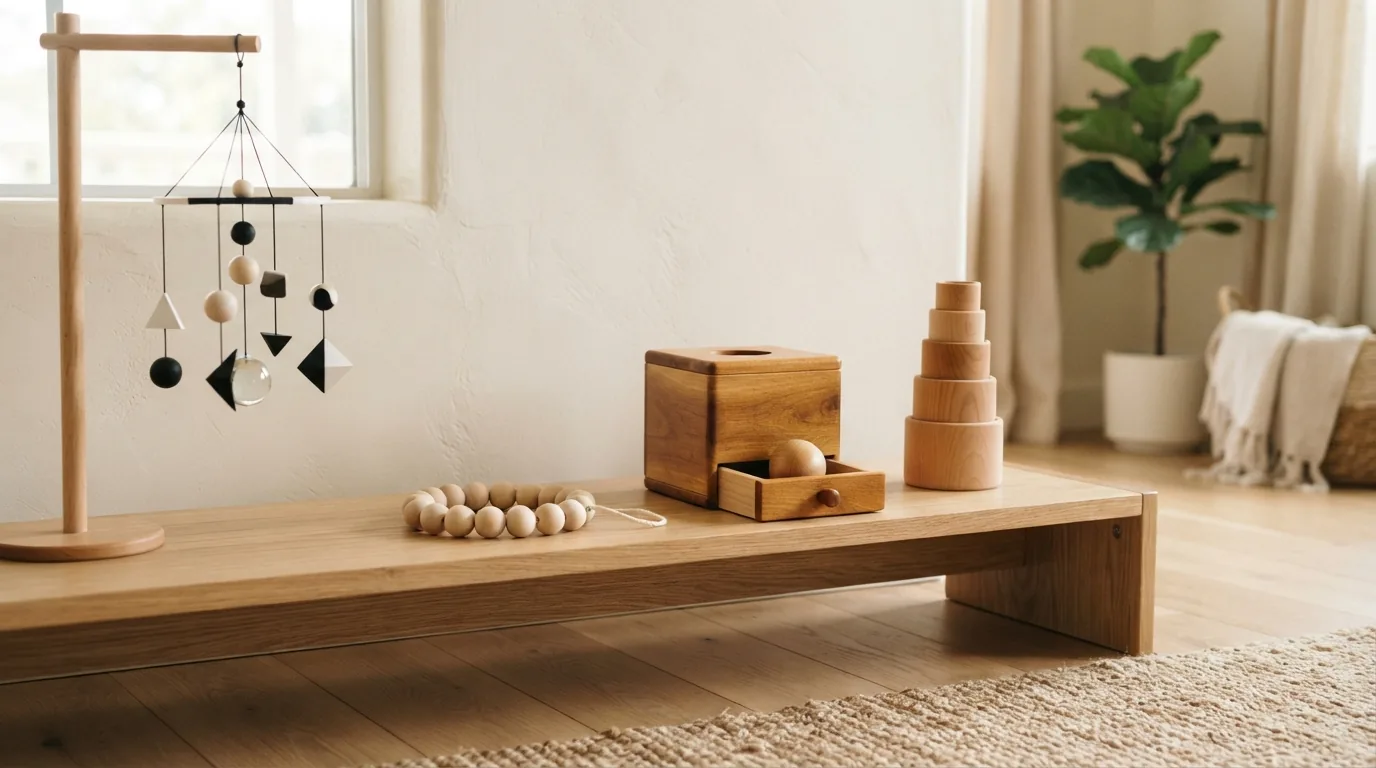
The best Montessori infant toys follow the baby, not the calendar on the box. In the first year that means a predictable sequence: high-contrast mobiles for a newborn who can barely focus past 12 inches, then grasping beads and rattles once hands wake up, then an object permanence box and a ball tracker as memory and tracking sharpen, and finally nesting and stacking toys for the emerging pincer grasp. Each stage isolates one skill the baby is actually working on right now.
This guide walks that sequence month by month, and explains why each material fits the stage instead of just listing gear. Every developmental claim is checked against CDC milestone guidance and AAP toy advice, and every toy is filtered for the three Montessori non-negotiables — real, natural, single-purpose — plus the safety rule that matters most under age three: nothing small enough to choke on. Use the comparison table to jump straight to your baby's age.
What Are the Best Montessori Toys for Infants 0–12 Months?
The best Montessori toys for infants follow a stage-by-stage sequence: high-contrast and Munari-style mobiles for newborns (0–3 months), grasping beads and simple rattles for 3–6 months, an object permanence box and a rolling ball tracker for 6–9 months, and nesting, stacking, and posting toys for 9–12 months. Choose natural materials, one skill per toy, and nothing that fits through a toilet-paper tube. You need five or six well-matched items across the whole year, not a bin.
How We Chose: Real Montessori Principles, Not a Catalog
Every toy here had to pass four filters. First, developmental fit — does it serve a skill the baby is building at that specific stage, per CDC milestone checklists? Second, the Montessori material test: reality-based and made of natural materials like wood, cotton, and metal, because Montessori practice deliberately roots infants in real objects rather than cartoonish plastic (Source: American Montessori Society, 2023). Third, single purpose — each material isolates one concept, so the baby can concentrate instead of being bombarded. Fourth, safety: nothing that fails the small-parts standard for under-threes.
This is a research-synthesis guide reviewed against CDC, AAP, and American Montessori Society guidance — not a sponsored roundup, and we name toy types and the attributes to look for rather than pushing brands. For where this sequence heads next, see our companion guide to Montessori practical life toys for toddlers, and for the philosophy underneath it all, open-ended toys.
Montessori Infant Toy Sequence at a Glance (0–12 Months)
Here's the full first-year progression in one view. Price key: $ = under $20, $$ = $20–50, $$$ = $50+.
| Stage | Toy type | Skill it builds | Price band |
|---|---|---|---|
| 0–6 weeks | Munari / high-contrast mobile | Focusing, early tracking | $ |
| 6–12 weeks | Octahedron & Gobbi mobiles | Color perception, depth | $ |
| 2–4 months | Dancers mobile | Sustained visual tracking | $ |
| 3–4 months | Batting toy on a stand | Reaching, cause-and-effect | $$ |
| 3–6 months | Grasping beads / interlocking discs | Grasp, hand-to-hand transfer | $ |
| 3–6 months | Wooden or silicone rattle | Grip, sound cause-effect | $ |
| 5–8 months | Treasure basket | Sensory exploration | $ |
| 6–9 months | Object permanence box | Grasp-release, memory | $$ |
| 6–9 months | Rolling ball tracker | Crawling motivation, tracking | $$ |
| 8–12 months | Nesting & stacking cups | Grading size, sequencing | $ |
| 9–12 months | Ring stacker | Pincer grasp, orienting | $ |
| 9–12 months | Coin box / single-shape sorter | Posting, hand precision | $ |
The classic Montessori infant progression, matched to skill and stage across the first year.
Montessori Toys for Newborns (0–3 Months): Vision Comes First
A newborn's most active sense is sight, so the first Montessori materials are visual, not tactile. At two months a baby "follows things with their eyes" and watches faces (Source: CDC, Learn the Signs. Act Early.). Their focal range is short and their color vision immature, which is exactly why the Montessori mobile series starts in black and white and adds color in a deliberate order. These are toys the baby works with while lying on their back — no hands required yet.
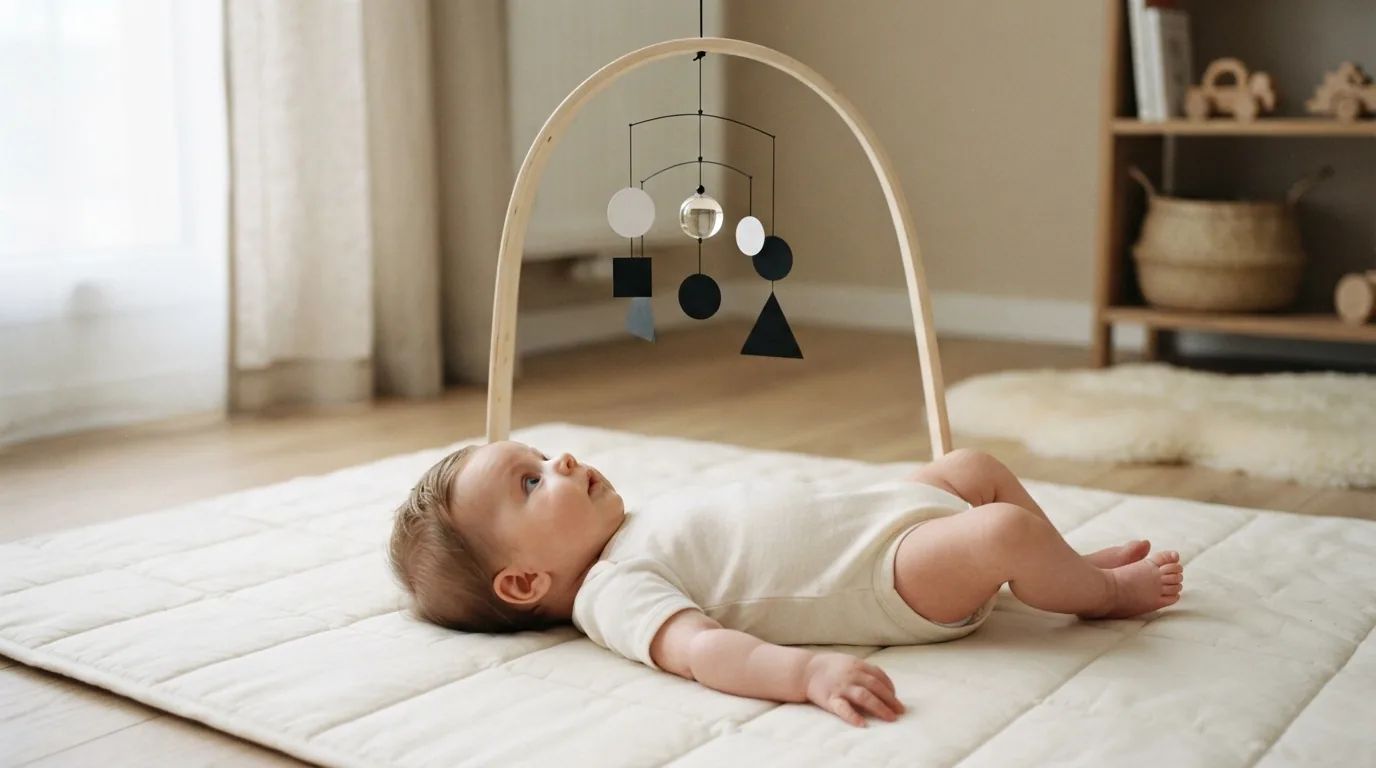
Munari mobile ($, 3–6 weeks). The classic first mobile: flat black-and-white geometric shapes and a glass sphere, balanced so it turns slowly in a draft. High contrast is all a newborn's retina can resolve, and the gentle motion invites those first tracking attempts. Hang it about 8–12 inches above the baby's chest and only during awake, supervised floor time — never over a crib for sleep.
Octahedron and Gobbi mobiles ($, 6–10 weeks). As color vision comes online, the shiny octahedrons introduce primary colors and reflected light, and the Gobbi — five balls in a single color graded light to dark — trains the eye to distinguish subtle shades. This maps neatly onto early color perception developing between roughly 6 and 12 weeks. A DIY felt-ball version costs a few dollars in yarn if you'd rather not buy.
Dancers mobile ($, 2–4 months). Lightweight metallic-paper figures that twist and "dance" with air currents, giving the baby irregular, unpredictable movement to track — a real step up from a slow spin. By now visual attention is stretching, and following a dancer across its arc is genuine exercise. It's the last of the four visual mobiles before hands take over as the star.
Montessori Toys 3–6 Months: From Watching to Grasping
Around three to four months the hands wake up. The baby now "reaches for toys" and "holds a toy when you put it in their hand," and everything heads straight for the mouth (Source: CDC). So the toys shift from things to watch to things to grab, mouth, and pass between hands. Keep them light, one-piece where possible, and safe to gnaw — the mouth is a primary research tool at this age.
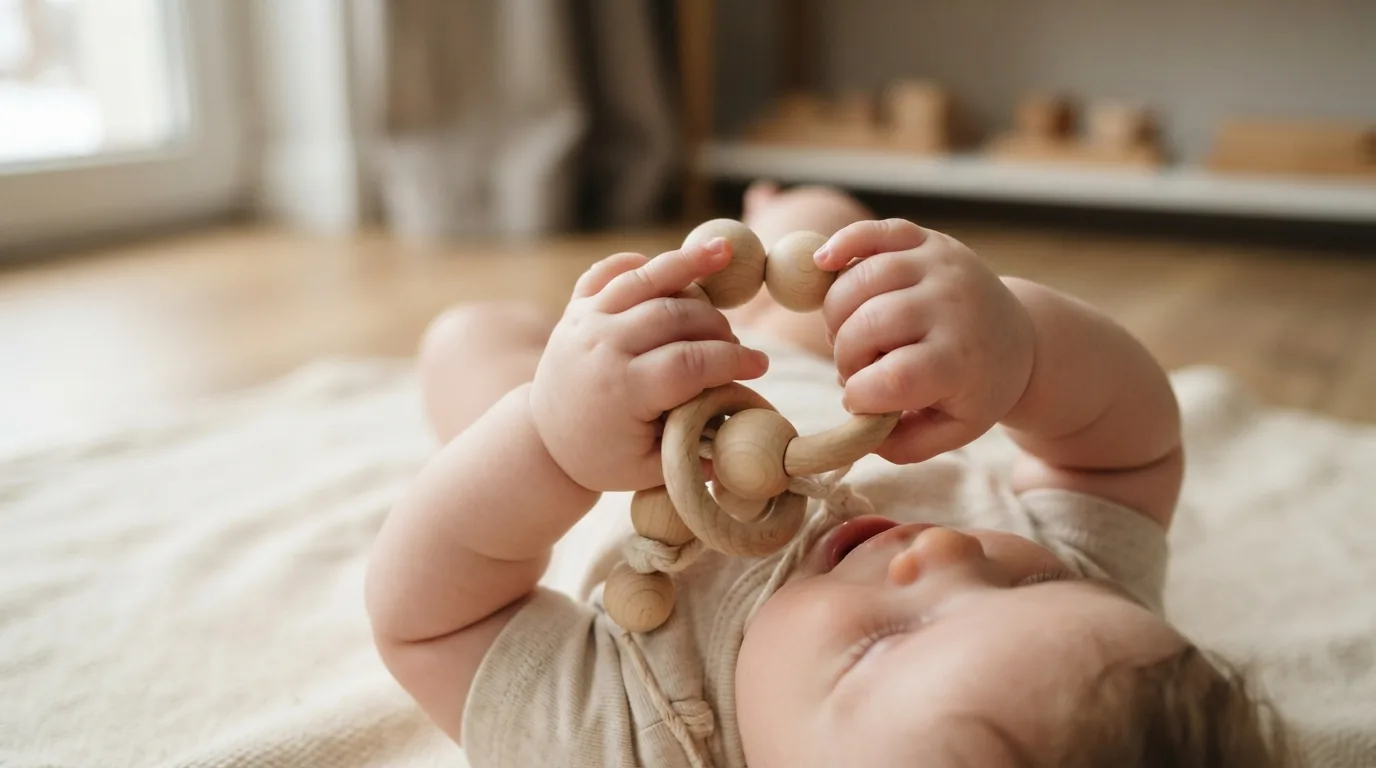
Grasping beads / interlocking discs ($, 3–6 months). A ring of smooth wooden beads or linked discs is easy for a whole-hand palmar grasp and light enough to lift, mouth, and transfer hand-to-hand — a skill emerging around this stage. Look for a single solid piece with no cord or small removable parts. Untreated or food-safe-finished wood is worth it since this will be soaked in drool.
Wooden or silicone rattle ($, 3–6 months). A simple rattle teaches the first cause-and-effect lesson: I move my hand, a sound happens. Choose one sized for a small fist with a gentle, not jarring, sound. Skip the multi-texture plastic rattles that light up and play tunes — that hands the "doing" to the toy, which is the opposite of the point.
Interlocking rings or a single teether ($, 4–6 months). A natural rubber or wooden teether does double duty as a grasping object and gum relief once teething starts. One-piece designs beat bead-strung ones for safety. This is also the age a batting toy on a low stand — a ball or bell suspended at arm's reach — rewards reaching with an audible or visual payoff.
Montessori Toys 6–9 Months: Object Permanence and Tracking
This is the stage most parents mean when they search for the best Montessori toys for a 6 month old — and it's a rich one. By six months babies reach and grab deliberately and put everything in their mouths to explore (Source: CDC), and by nine months they'll "look for objects when dropped out of sight" — the dawn of object permanence (Source: CDC). Sitting also frees the hands, and the urge to move drives crawling. The signature Montessori materials for 6–12 months speak to exactly these shifts.
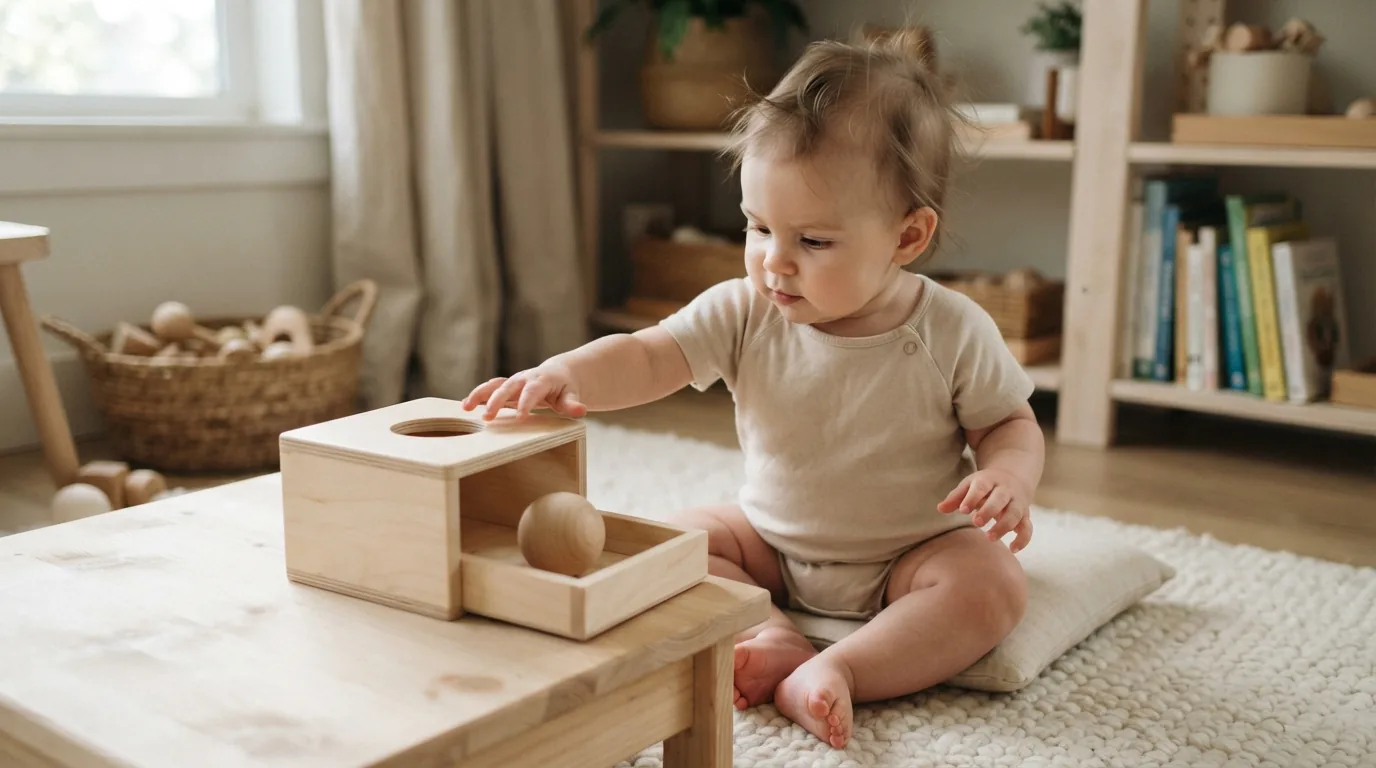
Object permanence box ($$, 6–9 months). A wooden box with a hole in the top and a tray: the ball is pushed in, vanishes, then rolls back into view. It rehearses grasp-and-release and delivers the cognitive lesson that hidden things still exist — perfectly timed to emerging object permanence. Genuinely absorbing for weeks, and one of the most-recommended first Montessori materials for this window.
Rolling ball tracker ($$, 6–9 months). A wooden ball or a fabric ball with sewn panels that rolls slowly and unevenly is a crawling magnet: it moves just far enough to chase but not so fast it's lost. Slow-roll balls are designed for exactly this. Confirm the ball is well over choke size — larger than a toilet-paper tube — before it goes on the floor.
Treasure basket ($, 5–9 months). Less a product than an assembly: a low basket of safe real objects — a wooden spoon, a metal whisk, a large pinecone, a fabric scrap, a big smooth shell. Real household objects out-fascinate most manufactured toys at this age, and the variety of weight, texture, and temperature does the teaching. Every single item must pass the choke test, and the basket is strictly for supervised sitting play.
Montessori Toys 9–12 Months: Nesting, Stacking, and the Pincer Grasp
By the end of the first year fine motor control gets precise. Around 12 months a baby "picks things up between thumb and pointer finger" — the pincer grasp — and starts putting objects into containers (Source: CDC). So the toys reward deliberate placing, posting, and stacking. These also bridge straight into toddlerhood, which makes them the best value in the whole guide.
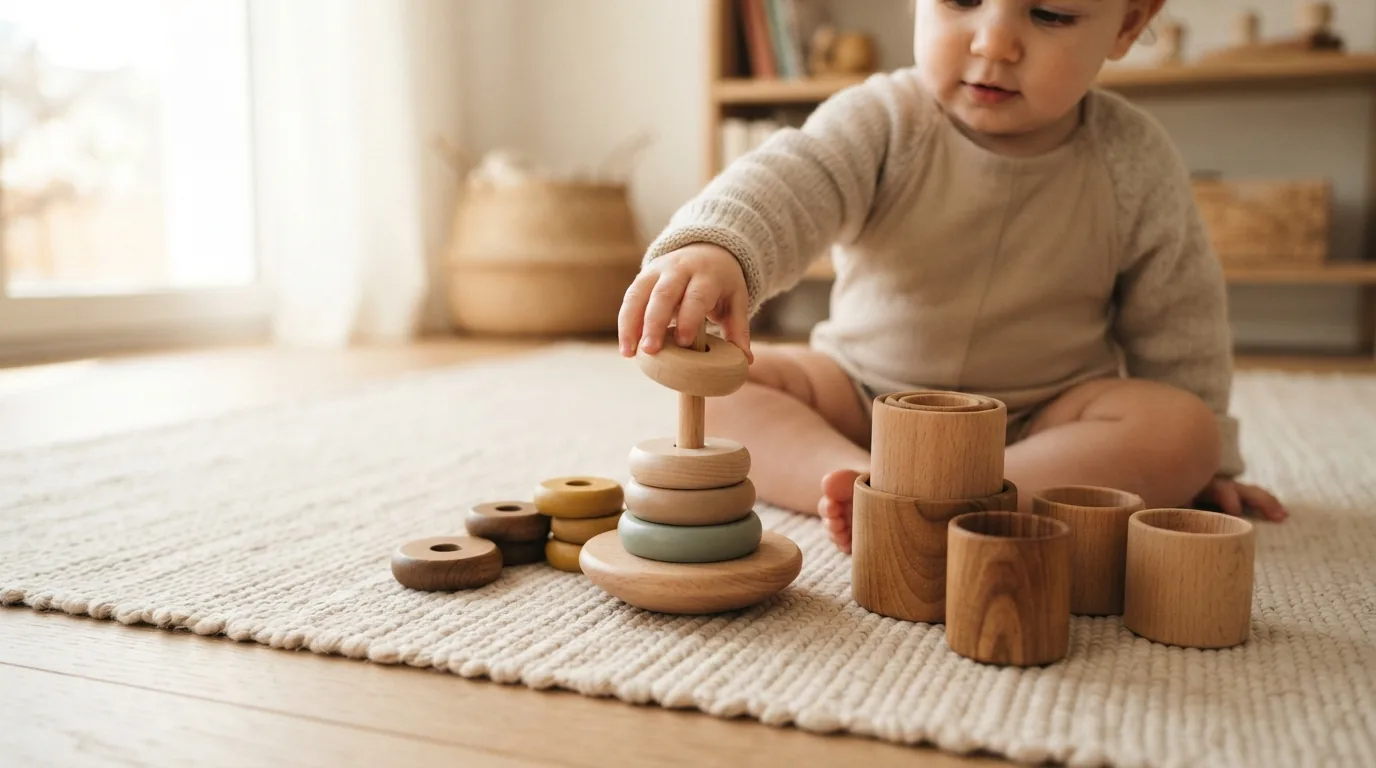
Nesting and stacking cups ($, 8–12 months). Arguably the highest play-value-per-dollar toy in the first year. Cups nest, stack, hide a ball, get dumped, and later become bathtub scoops and pretend teacups. Grading them by size is real cognitive work. If your budget is one toy for the 6–12 month stretch, this is a strong pick.
Ring stacker ($, 9–12 months). Grasping a ring, orienting it over the dowel, and releasing it is a complete fine-motor circuit that suits the sharpening pincer grasp. A straight (non-rocking) base with same-size rings is easier at first; save graduated rings for after the first birthday. Wooden versions with a weighted base won't tip when leaned on.
Coin box or single-shape sorter ($, 10–12 months). Start with a box that takes one shape — a slot for wooden "coins" or a single circle hole. Posting an object through a hole is the skill; multi-shape sorters just frustrate most babies before 18 months. It's the natural next step after the object permanence box, adding precision to grasp-and-release.
Safety First: The Choke-Hazard Rule for 0–3 Months and Beyond
The single most important filter for any infant toy is size. Under age three, U.S. safety rules ban small parts that fit inside a test cylinder about 1.25 inches wide and up to 2.25 inches long — roughly the diameter of a toilet-paper tube, which is the easiest at-home proxy (Source: U.S. CPSC, 16 CFR 1501). If a toy or any piece of it passes through that tube, it's out.
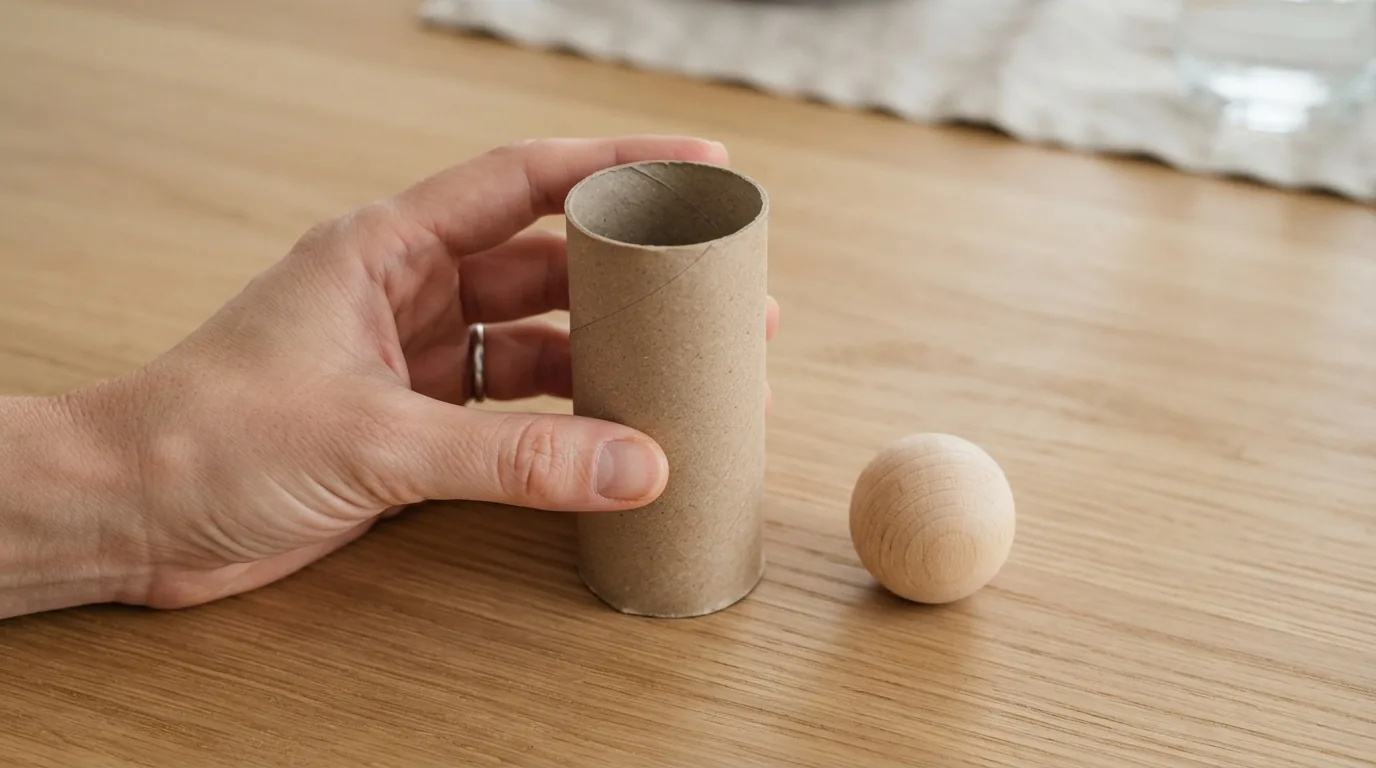
A few more rules that matter specifically for infants:
- No cords or strings over about 12 inches — a strangulation risk. Mobiles come down the moment the baby can push up on hands and knees or reach them.
- Nothing over a sleeping baby. Mobiles are for supervised, awake floor time only, never left in a crib.
- Check finishes. For toys that will be mouthed constantly, choose untreated wood or non-toxic, food-safe finishes.
- Inspect regularly. A loose bead, a cracked wooden ring, or a chewed-through seam turns a safe toy into a hazard. Retire anything damaged.
What to Skip: Toys That Undercut Montessori Principles
A handful of popular categories work against everything above, whatever the packaging claims.
Battery-powered light-and-sound toys. When the toy performs, the baby watches. AAP guidance is blunt that the best toys "need not be flashy or expensive or come with an app," and that simple toys drive more back-and-forth interaction than electronic ones (Source: HealthyChildren.org / AAP). The Montessori objection is identical in fewer words: the child should be the active one.
Screens of any kind. The AAP recommends no screen media before 18 months apart from video chat (Source: AAP, Media and Young Minds). A "learning" tablet shaped like a baby toy is still a screen.
Overcrowded activity centers. A cube with fifteen functions splits attention instead of building concentration. Toy abundance actually shortens and flattens play — in a University of Toledo study, toddlers given 4 toys instead of 16 played longer and more creatively with each (Source: University of Toledo, 2018). Rotate a few good materials instead. When your baby becomes a walker, the same logic carries into our 1-year-old gift guide.
FAQ
What are Montessori toys for a newborn?
For 0–3 months, Montessori "toys" are visual: the black-and-white Munari mobile first, then the colorful Octahedron, Gobbi, and Dancers mobiles as color vision and tracking develop. Newborns can't grasp yet, so these are hung 8–12 inches above the baby during supervised floor time, never over a crib for sleep.
What are the best Montessori toys for a 6 month old?
An object permanence box, a slow-rolling ball tracker, and a treasure basket of safe real objects. At six months babies reach, grab, and mouth deliberately, and object permanence is beginning, so toys that reward grasp-release and reward crawling toward a rolling ball fit the stage best. Confirm every item is larger than a toilet-paper tube.
Are Montessori toys good for 0–36 months?
Yes — the Montessori approach spans birth to three and beyond, shifting from visual mobiles (0–3 months) to grasping and object-permanence materials (3–12 months) to practical-life and problem-solving toys for toddlers. The same principles hold throughout: real, natural, single-purpose materials that let the child do the work.
What makes a toy "Montessori"?
Three things: it's reality-based rather than fantastical, it's made of natural materials like wood, cotton, or metal, and it isolates a single skill or concept. Montessori materials also keep the child active rather than entertaining passively, which rules out battery-powered light-and-sound toys (Source: American Montessori Society).
How many toys does a baby actually need in the first year?
Five or six well-chosen materials rotated across the year is plenty — one or two per developmental stage. Fewer toys lead to longer, richer play; in a University of Toledo study, toddlers with 4 toys engaged more deeply than those with 16 (Source: University of Toledo, 2018). Keep a few out and store the rest.
Are wooden Montessori toys safe for teething babies?
Yes, if they're one solid piece of untreated or food-safe-finished hardwood with no small removable parts, and you inspect them for cracks or splinters. For active teething, a natural rubber or one-piece wooden teether is safest. Retire any toy that develops a crack or a chewed-through seam.
Sources
- CDC — Milestones by 2 Months — follows things with eyes, watches faces.
- CDC — Milestones by 4 Months — reaches for toys, holds a toy placed in hand, brings hands to mouth.
- CDC — Milestones by 6 Months — reaches to grab a toy, puts things in mouth to explore.
- CDC — Milestones by 9 Months — looks for objects dropped out of sight (object permanence), sits without support.
- CDC — Milestones In Action, by 1 Year — pincer grasp, putting objects in a container.
- HealthyChildren.org / AAP — What to Look for in a Toy — open-ended, non-electronic toy selection.
- HealthyChildren.org / AAP — The Best Toys Go Back to the Basics — simple toys over flashy/electronic.
- AAP, Pediatrics — Media and Young Minds — no screen media under 18 months except video chat.
- American Montessori Society — Materials in the Infant & Toddler Classroom — reality-based, natural, single-purpose infant materials.
- U.S. CPSC — Small Parts for Toys and Children's Products (16 CFR 1501) — test cylinder ~1.25" × 2.25"; small parts banned for under-3s.
- University of Toledo — Fewer Toys Lead to Richer Play — Dauch et al., Infant Behavior and Development (2018).
More from Toy Guides
- Best Toys for 2 Year Olds: 20 Skill-Based Picks (2026)The best toys for 2 year olds, organized by the skills they build: gross motor, fine motor, language, pretend play and problem-solving, plus a price guide.
- Best Toys for 3 and 4 Year Olds (2026 Skill Guide)The best toys for 3 and 4 year olds by skill: pretend play, building, fine motor, gross motor, and puzzles, checked against AAP and CDC milestones.
- Montessori Toys by Age: The Practical-Life Guide (2026)What actually makes a toy Montessori (hint: not just wood) — plus the best picks by developmental area and age, with a practical-life focus.